Updated: Feb, 23 2026
Authors: Chai Him Chu
The life of a butterfly
Introduction
In this model, I will use a story about a butterfly’s lifecycle to help students understand how butterflies have a positive impact on the environment.
I think this topic is interesting and can help students learn more about the environment and how butterflies are connected to it. This is an interesting topic because people usually think of a butterfly as an insect that symbolizes beauty. People often overlook how butterflies have a positive impact on the environment and contribute so much to the ecosystem.
I think this model can help students easily understand things around them and inspire them to see that every animal or insect has value and a reason for being part of the ecosystem. It will help students understand that sometimes we should not only focus on appearance, but on value as well.
THE PROCESS OF THIS MODEL
Understand (Discover, Interpret, Specify)
Help children to know more about butterflies rather just how it looks, teach them how butterflies will impact and connect on the ecosystem.
CONTEXT AND AUDIENCE:
In this educational model, the primary audience is Grades 2–4, which means ages around 6–10. Instead of teaching them textbook knowledge, we should inspire them to learn more about things they might see daily.
To support children in early education, we should encourage them to think more and observe the world around them. Using things that are familiar to them can help them understand more easily and increase motivation and curiosity.
Moreover, because the audience is mainly children in early education, when designing the learning path, we need to be aware of the workload and overall learning design. By using comics and minimizing extraneous cognitive load, simple panel layouts and imagery will help students maintain focus. Therefore, I broke the lifecycle and the ecosystem impact into one stage per comic box.
In order to support students with different needs, I included simple text and images in the comic to help students understand better. Furthermore, considering that Grades 2–4 students can only maintain focus for a short time, the comic was created to be simpler, which can give students a big picture of the ecosystem.
POV STATEMENT:
Primary school students need to learn about the life cycle of butterflies and their contribution to the ecosystem. Therefore, the design of learning objectives and tasks should be low in difficulty, easy to understand, interesting, easy to master, and able to stimulate students’ interest in learning.
LEARNING OBJECTIVES:
Primary Objective:
Students will have a better understanding of each stage of the butterfly lifecycle after reading an educational comic.
Sub-objectives:
Students will have a better understanding of how butterflies contribute to the ecosystem after reading an educational comic.
Students will have a better understanding of why butterflies play an important role in the ecosystem after reading an educational comic.
Students will be able to share their thoughts and ideas with their group after reading an educational comic.
Plan (Ideate, Sketch, Elaborate)
IDEATION:
In order to draft my own comic idea, I made two comics about the butterfly’s lifecycle and how butterflies contribute to the ecosystem. I made the text very simple and easy to understand. Because the model targets students in early education, the content has to be designed more creatively, provide the basic idea, and avoid cognitively overloading students. This model will help students see the big picture of the butterfly’s lifecycle and how it changes at each stage. After gaining knowledge of the butterfly’s lifecycle, the next component I included shows how butterflies contribute to the ecosystem, which can help students learn about biodiversity and how things are connected. Therefore, I created two different comics that can help students learn and have a better learning experience.
To avoid a heavy workload and difficulty in understanding, I included only simple and easy text in each comic box. This can help students get a better picture of how the early stages of a butterfly change into an adult butterfly. After helping students develop a better understanding of the butterfly’s lifecycle, the next step is to help students understand how an adult butterfly contributes to the ecosystem. Because each step in the learning process is well designed and connected, this will help students develop a different understanding of this species and learn step by step.
Structure
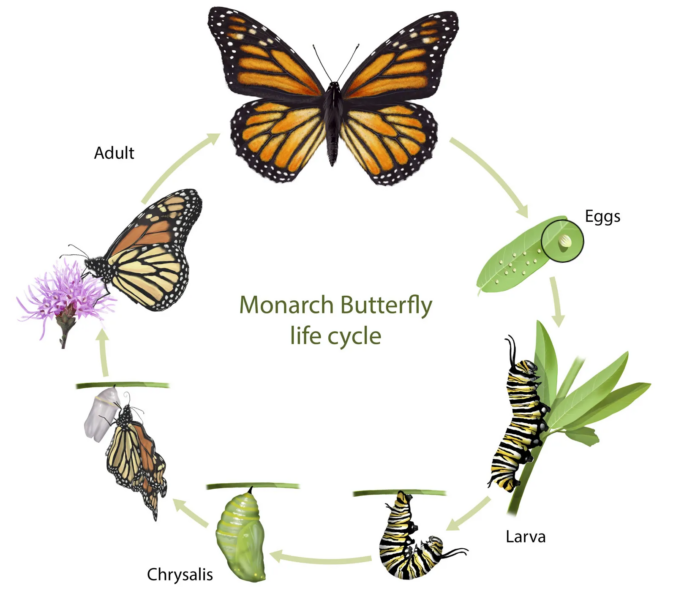
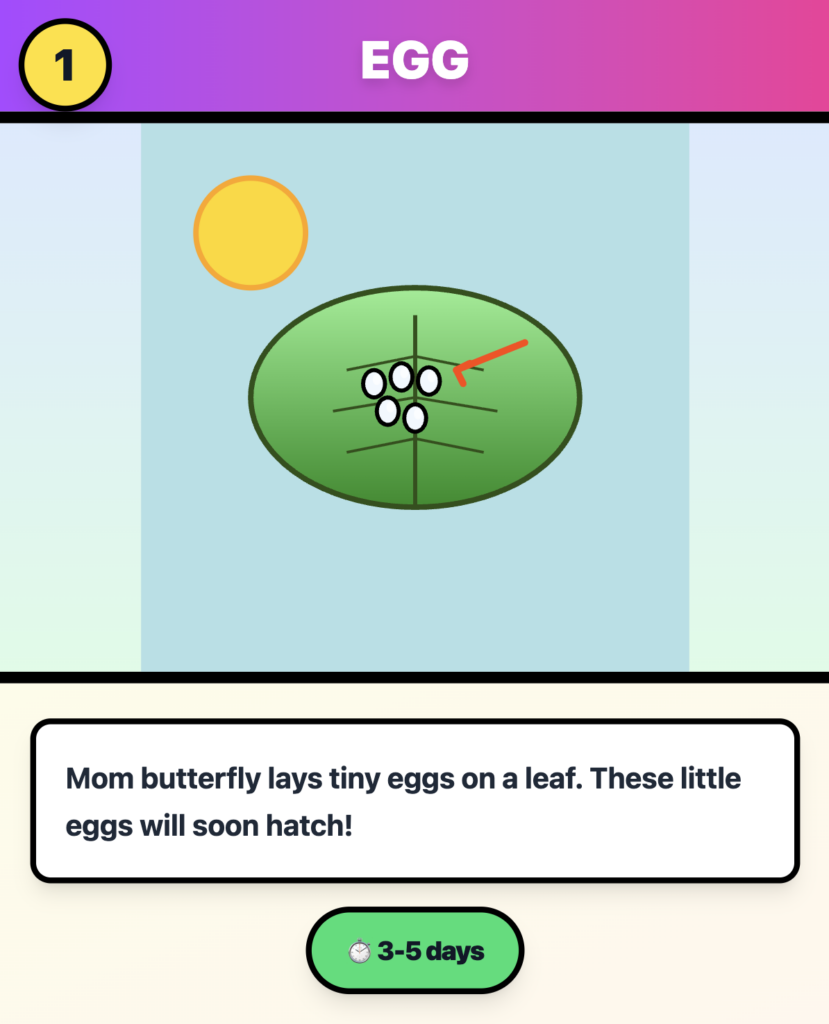
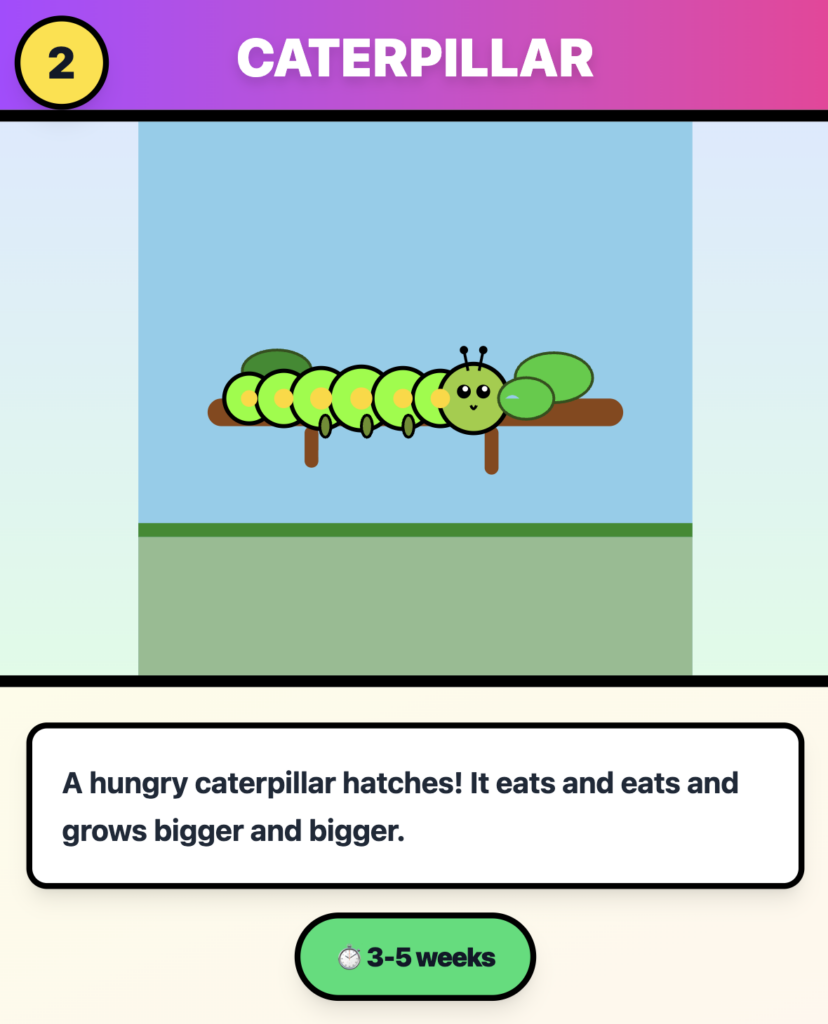
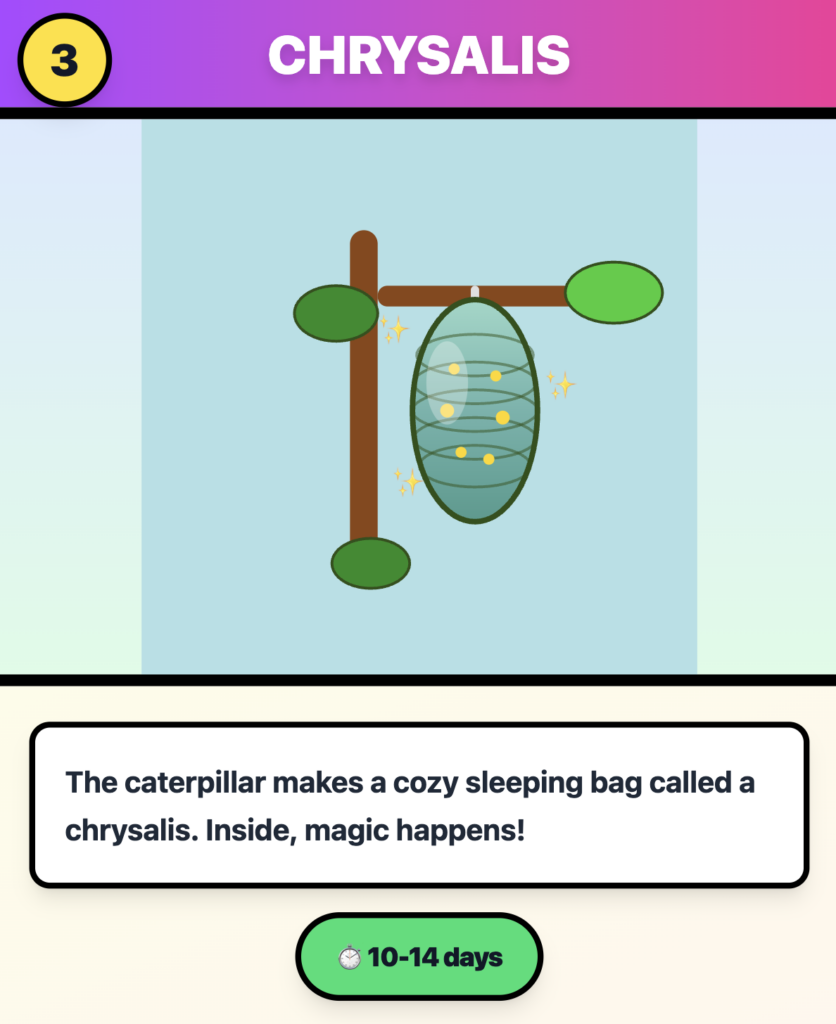
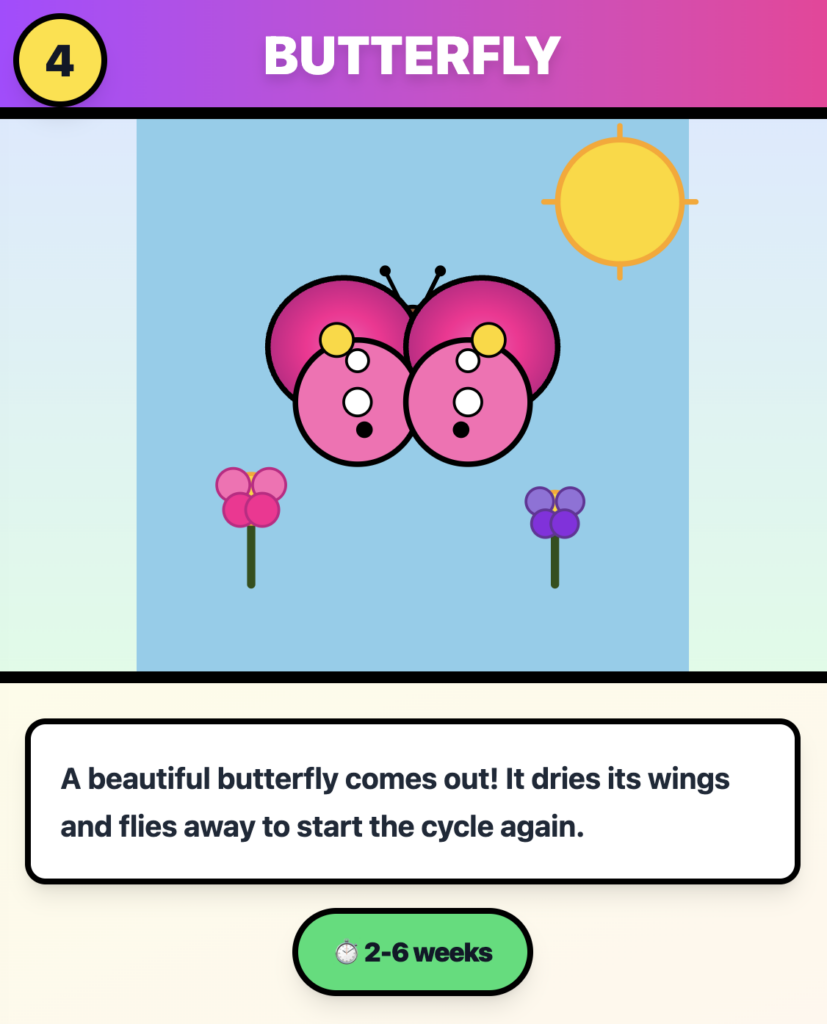
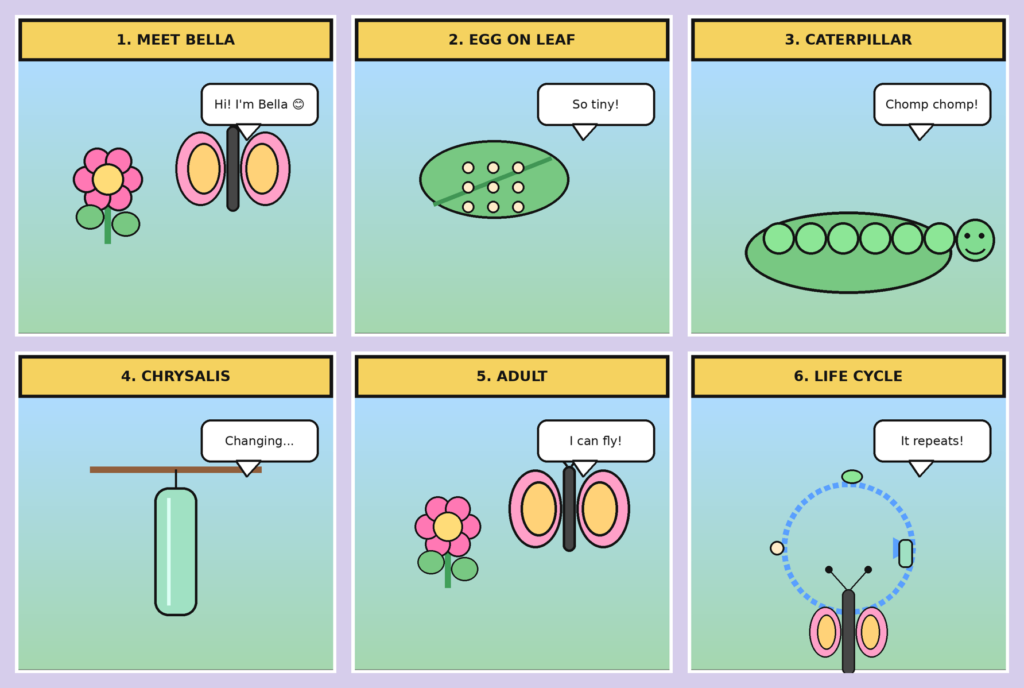
Butterfly’s lifecycle: Egg > Larva (Caterpillar) > Pupa (Chrysalis) > Adult Butterfly
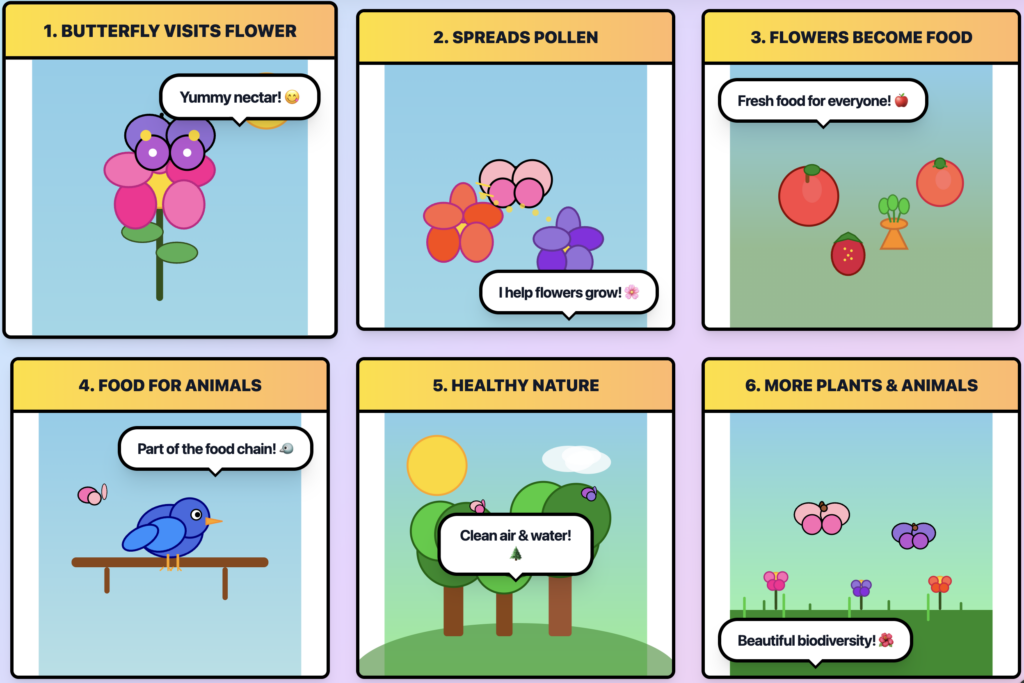
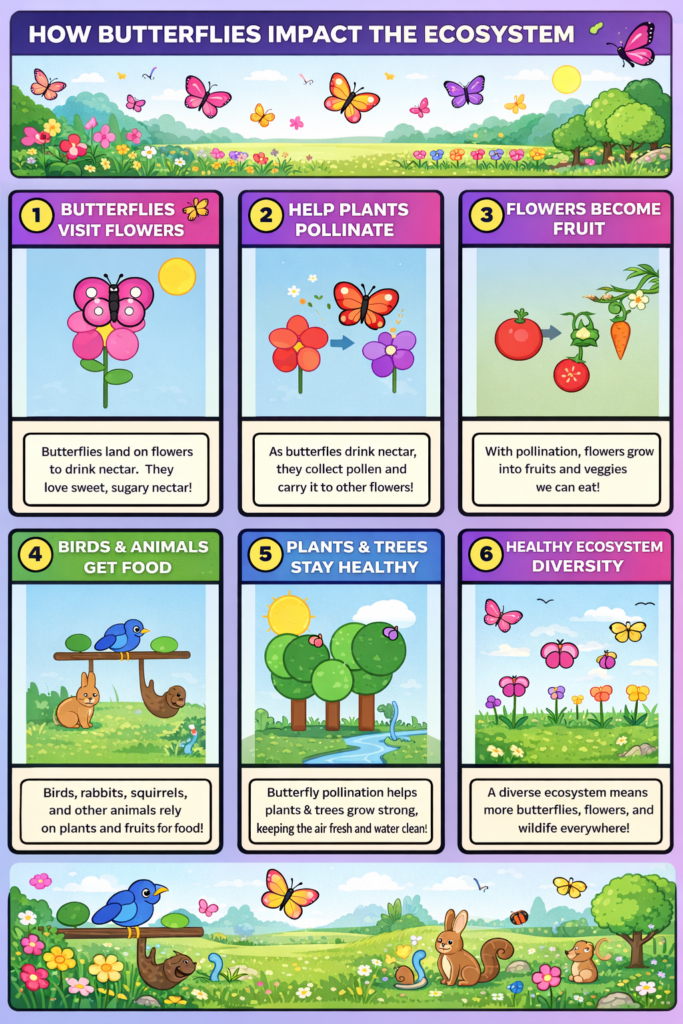
Butterfly impacts the ecosystem: An adult butterfly visits a flower > Butterfly spreads pollen > Flowers become food due to pollen > Animals get food > Nature stays healthy ecosystem cycle > More plants & animals
STORYBOARD OR SCRIPT
Butterfly’s lifecycle
How Butterfly impacts the ecosystem
THEORY APPLIED:
Universal Design for Learning (UDL): Employ a variety of representational methods (visual and textual), stimulate engagement (relatable things that students may see in daily life), and support expressive methods (students can be inspired to learn more deeply step by step).
Multimedia Learning Principles (Mayer): It reduces cognitive load and supports dual encoding by combining text and images.
Accessible Multimedia: I included images and simple text to ensure students can receive the knowledge even if they have different needs.
Cognitive Load Theory: Since the target audience is children in early education, I included only simple text and created images that can help students learn. The model provides a big picture of the butterfly lifecycle and how it impacts the ecosystem. This can help connect the knowledge to their real life.
Merrill’s Principles of Instruction: Throughout the learning process, students may learn about things they often see in real life, but may not have realized the knowledge or value behind them. Therefore, through this model, the new knowledge is incorporated into learners’ world when they reflect on aspects of the butterfly that they admire or respect and share their findings with peers.
PEER FEEDBACK:
The thing that came up the most in terms of strengths was that my comic and model are well designed and age-appropriate for Grades 2–4. In the model, I use simple text and clean panels. I made two different comics: one shows the butterfly’s life cycle, and the other shows how butterflies have a positive impact on the ecosystem. This reduces overwhelm and matches Cognitive Load Theory. In the visual design, I use a consistent layout and uncluttered panels, which help readers keep their attention on the main idea. In the project, I connected well to learning theories such as Multimedia Learning, Accessible Multimedia, UDL, and Merrill’s real-world learning. Students may apply their knowledge and understanding of butterflies and pollination to nature. The second comic adds depth by showing cause and effect. It goes beyond “butterflies are pretty” to “butterflies matter.”
The biggest area for improvement that both peers pointed out was that I could create stronger connections between the two comics. Moreover, they also noted that I could make the butterfly in the comic more beautiful, which could help students have a better learning experience. Therefore, I made some changes in my final design. I recreated the comic to be more interesting and added stronger connections between the two comics. I believe these changes will help students learn and focus on the message that I would like to highlight.
Reflect and Refine
REFLECTION:
The things that worked best in the prototype were that I used simple and clean text, since extra material adds extraneous cognitive load and should be removed (Mayer, 2009). Both peers confirmed this. However, they also thought that I should add stronger connections between Comics 1 and 3 and create more beautiful and interesting images to help students stay focused on the model. This would better support the coherence principle.
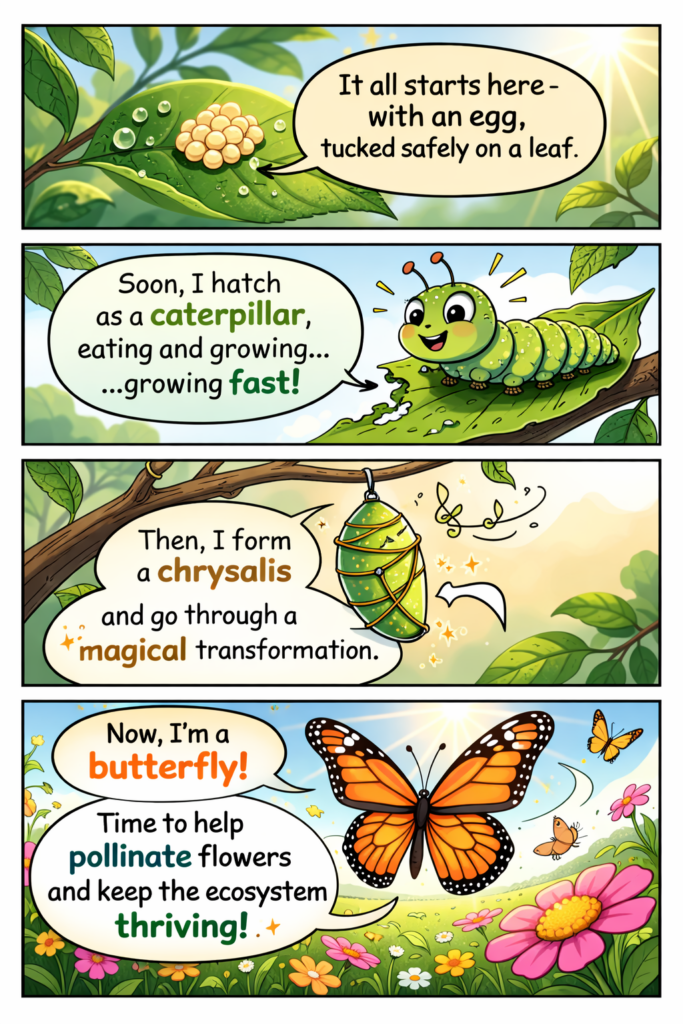
Therefore, based on the feedback, I made several revisions. In the first comic, I used four panels to introduce the butterfly’s life cycle. This provides students with a basic understanding of how the butterfly changes shape at each stage. In the second comic, I used a more interesting style to help students understand what has changed in the butterfly and to strengthen the connection between Comics 1 and 3. In the last comic, I recreated the images to make the butterfly more visually appealing and to help students focus on the positive impact butterflies have on the ecosystem.
In this learning format, I designed the comics to support dual coding by combining clean images with simple text. This allows readers to learn through both visual and verbal channels (Paivio, 1986). The model structure also follows the segmenting principle by presenting the message across different panels and different comics (Mayer, 2009). This helps readers learn step by step through the model. Overall, I think the peer feedback provided really useful suggestions. There were points I overlooked, such as the connections between different comics. The peer feedback helped me recreate my comic and learning model to give students a better learning experience.
Final Comic
References
AI-Generated Picture References:
All prompts using: ChatGPT and Canva AI
Butterfly’s lifecycle: Egg > Larva (Caterpillar) > Pupa (Chrysalis) > Adult Butterfly
Butterfly impacts the ecosystem: An adult butterfly visits a flower > Butterfly spreads pollen > Flowers become food due to pollen > Animals get food > Nature stays healthy ecosystem cycle > More diverse ecosystem = more plants & animals
Granchelli, A. (2025, November 2). Accessible Multimedia. University of Victoria: Educational Technology. https://edtechuvic.ca/edci337/2025/11/02/accessible-multimedia/
Granchelli, A. (2025, October 19). Models of Active Learning. University of Victoria: Educational Technology. https://edtechuvic.ca/edci337/2025/10/19/models-of-active-learning/
Granchelli, A. (2025, September 14). Storytelling. University of Victoria: Educational Technology. https://edtechuvic.ca/edci337/2025/09/14/storytelling/
Granchelli, A. (2025, September 5). Theories of Multimedia Learning. University of Victoria: Educational Technology. https://edtechuvic.ca/edci337/2025/09/05/theories-of-multimedia-learning/