Developing a Personal Approach to AI and Digital Literacy
In this reflection, I will focus on how to develop a personal approach to AI and digital literacy. I think this topic has encouraged me to think more about how digital literacy shapes my choices as a student and how it will become part of my life. I think AI is becoming a common and useful tool that can provide support for people with different needs. Therefore, this has caused me to think about how to use AI correctly and how it can be beneficial to me.
One of the quotes I would like to highlight from this video is, “The youth of today are the leaders of tomorrow, and their skills and potential can change the world.” Therefore, I think digital literacy is more than just knowing how to use technology. It means using technology in the right and efficient way so that it is beneficial to you. Therefore, I think the value of evaluating information, questioning sources, and recognizing bias is the first thing people should understand before using AI in their learning.
GPT-3, GPT-Neo/J, GPT-2 and a T5-based model. The best model was truthful on 58% of questions, while human performance was 94%. Models generated many false answers that mimic popular misconceptions and have the potential to deceive humans. Lin, S., Hilton, J., & Evans, O. (2022).
Therefore, we need to understand the advantages and limitations of AI. That will help people study more effectively. For example, I think AI’s strengths are organizing ideas, improving grammar, and searching for resources. This can help users save a lot of time during those processes. However, this does not mean users can fully trust AI’s work. They still have to fact-check the information and make sure the information they receive is correct. By knowing this, I think AI can be a useful assistant.
Lastly, and most importantly, people should not rely on AI too often and should never let AI replace their thinking. This is because when you learn or do something on your own, it helps you develop skills. If you rely too much on AI, you will lose opportunities to develop important skills. Therefore, it is important to understand that AI can only be an assistant tool that helps you with different tasks, but you are the one leading the process.
By watching this video, I think it is very inspiring and made me think about the future of education. I personally believe there are always pros and cons, and it really depends on how the user uses the tools correctly. At this point, I still think AI is just a large language model, and students should not rely too much on it. At the same time, students also need to know how to use AI because it represents the future.
reference
Lin, S., Hilton, J., & Evans, O. (2022). TruthfulQA: Measuring how models mimic human falsehoods. Proceedings of the 60th Annual Meeting of the Association for Computational Linguistics, 3214–3252.
Accessibility and AI in Professional Technology Use
IIn this week’s topic, when it comes to accessibility and AI in professional technology use, it inspired me to think about how AI helps and supports people with different needs. Since AI can increase people’s work performance, I think it can be a great tool to help people with visual, hearing, cognitive, or physical disabilities have better accessibility in learning.
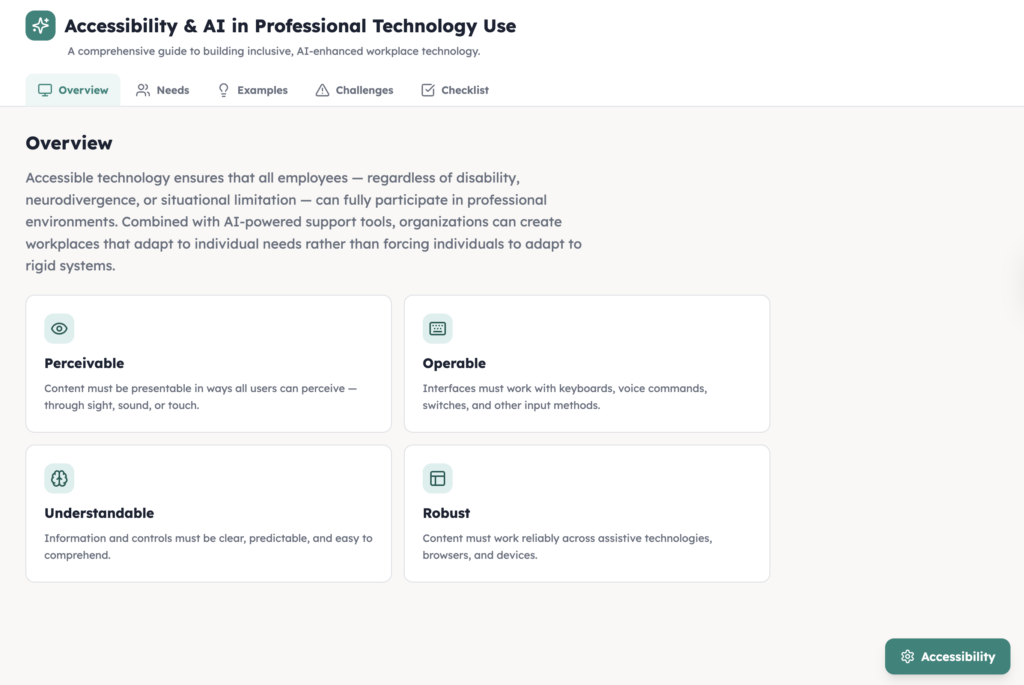
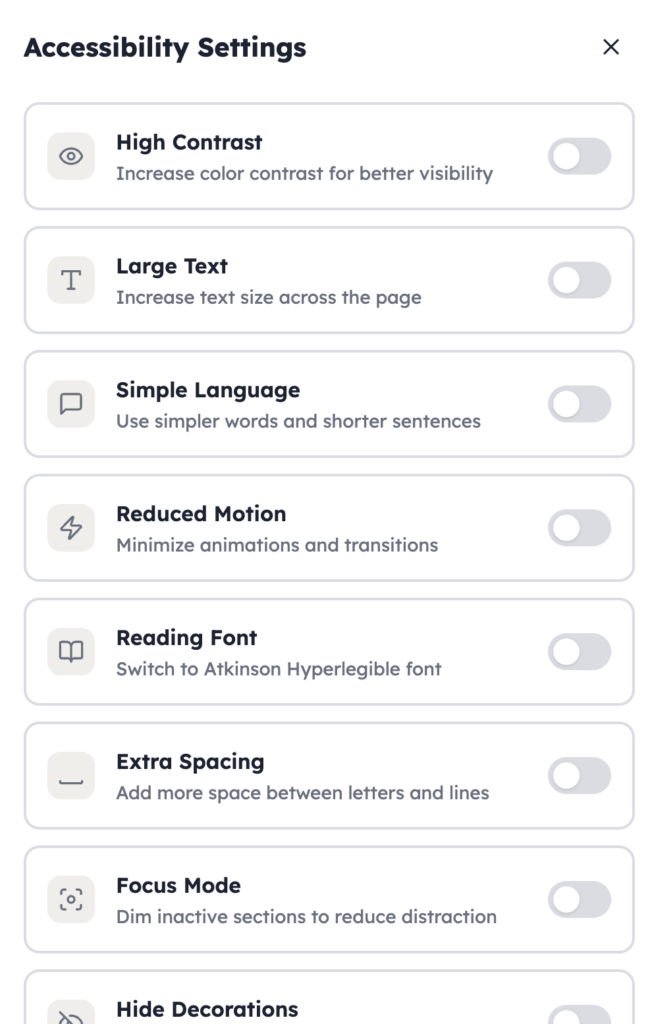
I would like to use an example to introduce this topic by sharing the content I created using AI. I think AI adds another layer to this discussion, thus I have used AI to create a website that includes accessibility features. https://edci136-1.lovable.app
On the website, people may select the accessibility settings, and there are different sections that they can choose from. This will help take care of people with different needs. By adding different features for people to select when needed, this will support all kinds of people with different needs. AI is playing an important role in redesigning the webpage for people with different needs. This takes less than an hour; the creator only needs to know the basic code and the commands to give to AI, and then AI will redesign the webpage and publish it for everyone.
However, AI also has limitations and risks. Therefore, people should avoid overrelying on AI. It is important to know how to use different skills to help people with different needs. AI is just a tool that helps by providing more options and saving time when it comes to designing the learning process for learners.
In conclusion, accessibility and AI in professional technology use have a strong connection, and by using AI, it can help take care of people with different needs. The preparation work will not take too long, and it can maximize the benefits while reducing the costs of caring for all kinds of people.
const disabilityGroups = [ { title: “Visual Disabilities”, icon: Eye, needs: [ “Screen-reader friendly headings and navigation”, “High contrast colors and readable fonts”, “Alt text for images, diagrams, and icons”, “Clear labels for buttons, forms, and links”, ], example: “A worker with low vision may rely on zoom, screen readers, and clear page structure to read workplace documents and online systems.”, simple: “People with visual disabilities may need larger text, stronger contrast, and screen-reader support.”, }, { title: “Hearing Disabilities”, icon: Ear, needs: [ “Captions and transcripts for audio and video”, “Text alternatives for spoken content”, “Visual alerts instead of sound-only alerts”, “Clear written instructions and summaries”, ], example: “A Deaf employee may use captions and written summaries during virtual meetings so they can follow discussion clearly.”, simple: “People with hearing disabilities may need captions, transcripts, and visual alerts.”, }, { title: “Cognitive Disabilities”, icon: Brain, needs: [ “Plain language and shorter sections of text”, “Consistent page layout and navigation”, “Reduced information overload”, “Step-by-step explanations and clear instructions”, ], example: “An employee with attention or processing challenges may benefit from simple wording, predictable layouts, and shorter tasks.”, simple: “People with cognitive disabilities may need simple language, clear structure, and less clutter.”, }, { title: “Physical Disabilities”, icon: Hand, needs: [ “Full keyboard navigation”, “Large buttons and easy click targets”, “Voice input and speech-to-text support”, “Compatibility with assistive devices”, ], example: “A worker with limited hand mobility may use keyboard shortcuts or voice input instead of a mouse.”, simple: “People with physical disabilities may need keyboard access, voice tools, and bigger buttons.”, }, ];
const examples = [ { title: “Accessible Meetings”, detail: “Meeting platforms should include captions, transcripts, readable chat, speaker labels, and keyboard-friendly controls.”, simple: “Online meetings should have captions, readable chat, and easy controls.”, }, { title: “Accessible Documents”, detail: “Professional documents should use headings, plain language, alt text, good contrast, and consistent formatting so more people can read them.”, simple: “Work documents should be clear, organized, and easy to read.”, }, { title: “Accessible Training”, detail: “Training materials should offer multiple formats such as text, captions, visuals, and step-by-step instructions.”, simple: “Training should come in more than one format.”, }, { title: “Accessible AI Tools”, detail: “AI tools should help with summaries, captioning, voice input, and readability, but their output should still be checked by people.”, simple: “AI can help, but people should still review the results.”, }, ];
const challenges = [ “AI captions or transcripts may be inaccurate”, “Some websites look modern but do not work with screen readers”, “Complex pages can overwhelm users with cognitive disabilities”, “Small buttons and mouse-only design can block users with physical disabilities”, “Bias in AI tools can affect fairness in hiring or workplace decisions”, “Organizations may add AI without explaining how it works”, ];
const checklist = [ “Use strong contrast and readable font sizes”, “Support screen readers and keyboard navigation”, “Provide captions, transcripts, and text alternatives”, “Write in plain language and break information into sections”, “Keep buttons large and easy to select”, “Reduce clutter and avoid unnecessary motion”, “Check AI output for accuracy, bias, and accessibility”, “Keep human review for important decisions”, ];
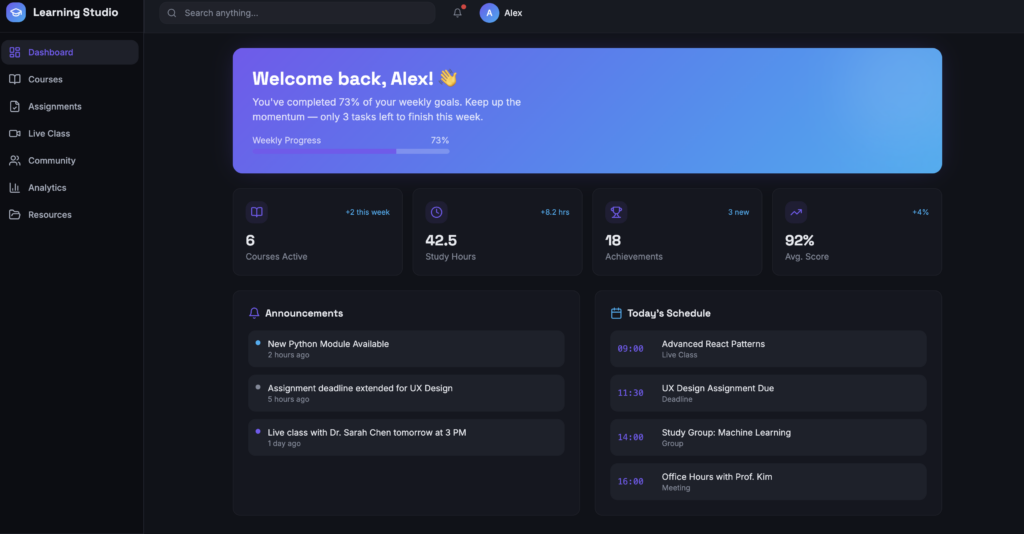
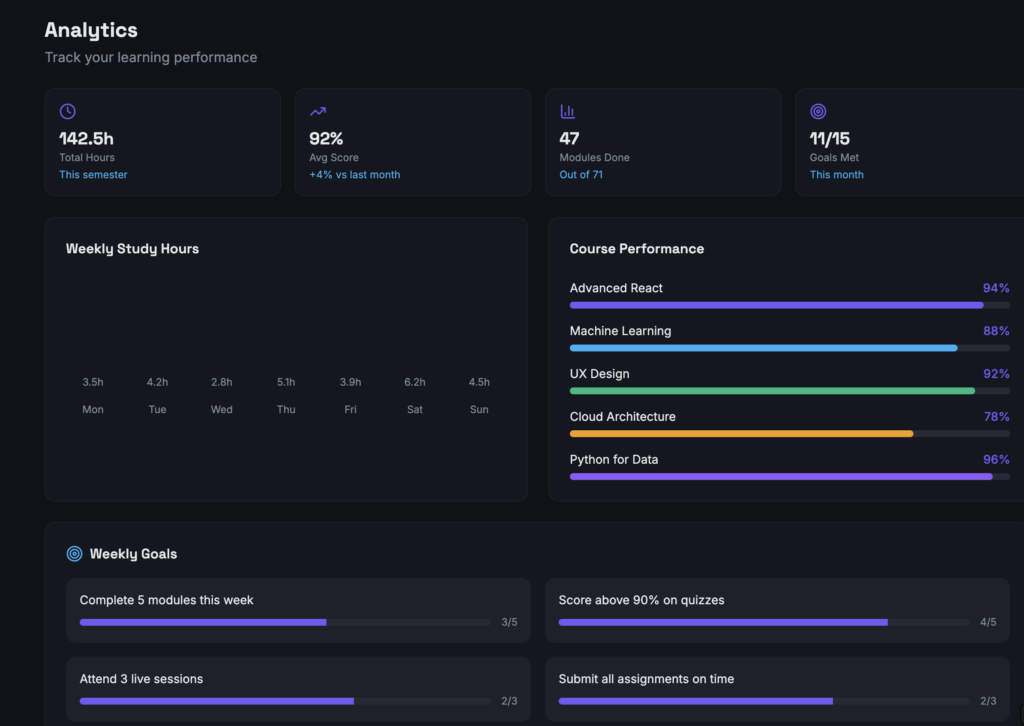
In order to improve self-learning, students may now track their own learning process through this website. On this website, there will be different sections that show students’ performance, active time, and goals. The website will show the results to students, and students may find it easier to track their learning process. Moreover, by including AI to analyze student performance, students may receive feedback from the AI, and teachers may see their results on their end. Teachers can redesign their teaching by understanding students’ areas of weakness. This will maximize the learning experience and help students improve their academic performance.
By using this website, teachers will understand their classes better. Teachers will no longer rely only on textbooks to teach students. They may address students’ weaknesses and identify what they need more help with. The teaching method will no longer be one-way; instead, it will involve feedback and redesign depending on students’ needs.
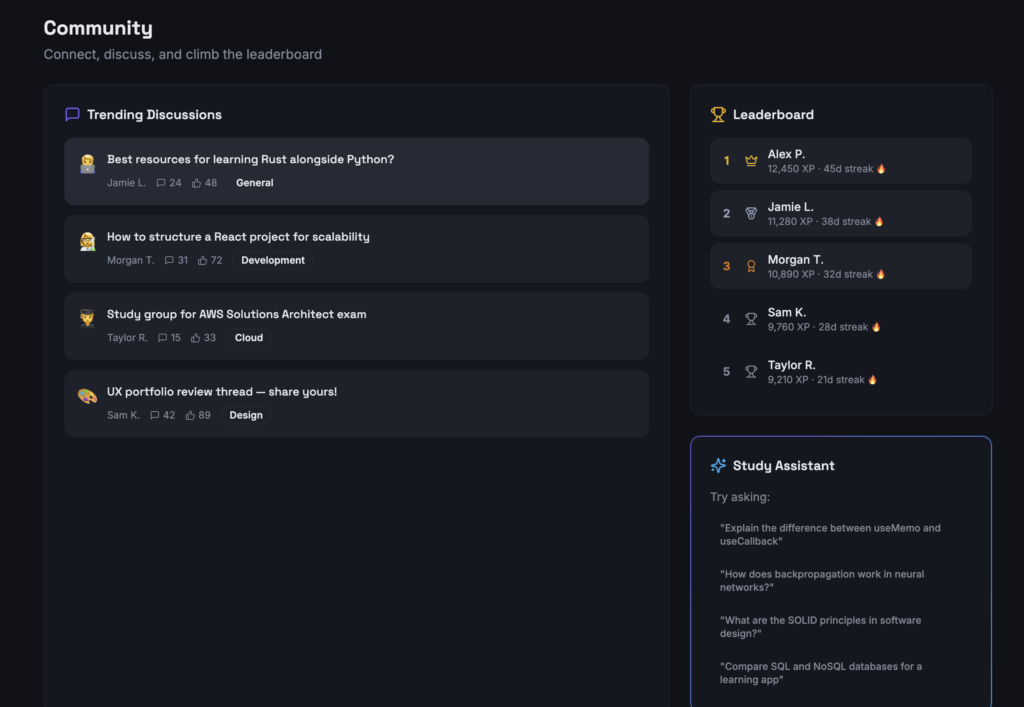
On the other hand, I have added a community feature to this website, which will encourage students to be more active and participate in class more often. By setting up some competitions, such as a leaderboard, it will encourage students to be more active in learning outside of class. Moreover, students may exchange their ideas and thoughts in the community. They will be able to learn outside of the classroom.
After talking with Instructor Adrian Granchelli, I had a great conversation with him. He has a Master of Educational Technology and is currently pursuing a PhD in Educational Studies with a focus on educational technology at the University of Victoria. As a PhD student and a contract instructor at UVic, he shared his opinions on different questions. Here are his opinions on each question.
Adrian Granchelli’s thoughts:
Do you think AI should be used more as a tutor, a teaching assistant, or a teaching tool in classrooms? Why?
Teachers may provide review and personal feedback, but AI cannot.
How is AI changing the role of teachers compared with traditional classrooms?
This is a big change for both teachers and students. For example, the way AI is breaking into today’s society is similar to how the internet was introduced to the world in the 2000s. Therefore, Adrian believes that AI can accelerate the learning and studying process.
How can AI improve student independence, or could it make students rely too much on technology?
Yes, there is a risk and a negative effect on student learning, since AI is considered a large language model. Therefore, it can limit people’s ability to remember things, and students may become overly reliant on technology rather than using their own brains. For example, because of the Google effect, students may simply search for the answer directly without going through any learning process in between. This can be harmful to student learning.
How will AI change the relationship between teachers and students in a positive or negative way?
Instructor Adrian hopes that teachers will be able to use their social skills and have a better connection with students in the future. Moreover, he also mentioned that teachers have been devalued in today’s society. Since AI will never be able to replace teachers, he thinks that the value of teachers has been overlooked by the education system.
In your opinion, what skills will students need most in an AI-classroom environment?
He mentioned that it is important to have evaluative judgment and critical thinking skills. These two skills will be useful and help students learn and receive the right information. Therefore, teachers should spend more time teaching students how to apply these skills in their self-learning with AI.
How should schools balance the benefits of AI with concerns about bias?
He mentioned that AI usually provides one answer, and students often think that it is the only answer. This is a huge misunderstanding and can mislead students in learning. Therefore, teachers should teach students critical thinking skills so they can apply their knowledge when it comes to self-learning with AI. AI cannot provide the full picture of what you are looking for. Therefore, he mentioned that students need to learn how to learn outside of AI, fact-check the information they receive, and seek help or confirmation from teachers when they find something online or through AI. Teachers will be the ones who guide them on the right educational path.
In conclusion, there are pros and cons when you use different tools, and it depends on how you use them in your learning. it is important to know how to use the tools in the right way, and that will help you learn more effectively. One thing is that we are now watching a huge milestone of education changing in the next few years.
In today’s topic, I will be focusing on how AI is changing the roles of teachers and students. I think this is really interesting to explore. By 2025, AI has become smarter and more accurate in providing answers to users. Many educational platforms have also included AI in their systems. Even Google, Adobe, Facebook, and many other things around us have been incorporating AI. Therefore, education is also reaching a milestone in 2025.
People know that education means helping students learn knowledge before entering society. Therefore, that knowledge has to be related to today’s world and up-to-date information. Preventing students from using AI will limit their learning potential; therefore, teaching students how to use AI is the right approach, and AI can be a great assistant tool while studying.
First, what are AI classrooms?
AI classrooms mean that studentS are allowED to use AI in the classroom. Ai will help student learning in the classroom as an assistant.
How AI is Changing the Role of Teachers and Students
There are some common misunderstandings people have about using AI in the education system. First, it is important to make it clear that using AI does not mean that teachers will be replaced by AI. AI can be a great tool for engaging students through “structured feedback,” “interactive scaffolding,” and “personalization alignment.” Students can benefit from these supports in their learning process.
On the other hand, teachers can also benefit from AI by using it for “lesson planning,” “personalized feedback,” and “administrative tasks.” Therefore, teachers will be able to spend more time discussing with students, focusing on student relationships, and guiding students toward deeper learning experiences rather than spending all their time on routine work.
Furthermore, teachers have the responsibility to teach students how to think critically and not trust AI too easily. Teachers should highlight that it is important to check whether the information students receive from the internet or AI is true or not. Without critical thinking, students may accept biased or misleading information without questioning it.
For example, when users are using Claude, it is important for students to know how to properly use certain code inputs in the AI system. Once those codes are entered into the system, they can help the AI understand and answer questions more accurately. Therefore, teachers can be the ones who teach students how to use AI, rather than letting them use it only to look for answers without any learning.
Therefore, the education system should change its structure and be open-minded about students and teachers using AI in the classroom. It is important to make sure the roles are clear and to consider what teachers should focus on more when the education system includes AI learning. Teachers will still be able to provide support that AI classrooms cannot provide, such as personalized feedback and discussions with different students.
In conclusion, I think it is important for the education system to teach students and teachers how to use AI in the right way. Furthermore, teachers should know how to guide students in using AI properly so they can learn more effectively. Eventually, using AI properly can provide a more effective method of learning.
Reference
Long DY, Wang S, Md Rashid S and Lu XT (2026) Artificial intelligence in higher education: a systematic review of its impact on student engagement and the mediating role of teaching methods. Front. Educ. 10:1648661. doi: 10.3389/feduc.2025.1648661
In today’s topic, the speaker has focused on the relationship between digital literacy and democracy. Before I listened to the speaker, I had never thought of the relationship between digital literacy and democracy. I don’t even know if there is a strong relationship between.
In this video, I think this helped me to understand more about the relationship between digital literacy and democracy.
In the speaker’s speech, she mentioned how misinformation and manipulation can directly affect democratic participation, which I had never thought of. This has made me think about how Canada has been working on this issue since misinformation is a common issue in today’s society. Furthermore, AI is a powerful tool that can create some fake information. The thing is Ai can even create a fake video that can mislead people. This makes me really curious how Canada stops or prevents this issue.
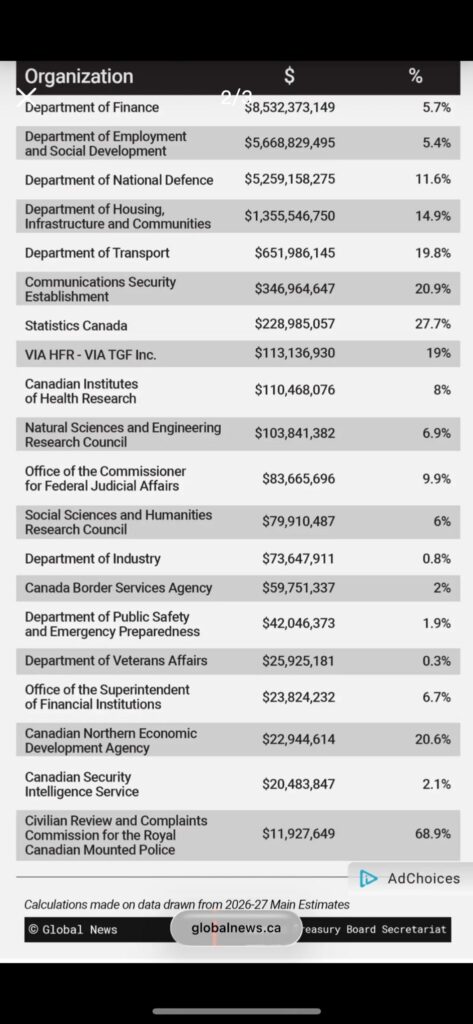
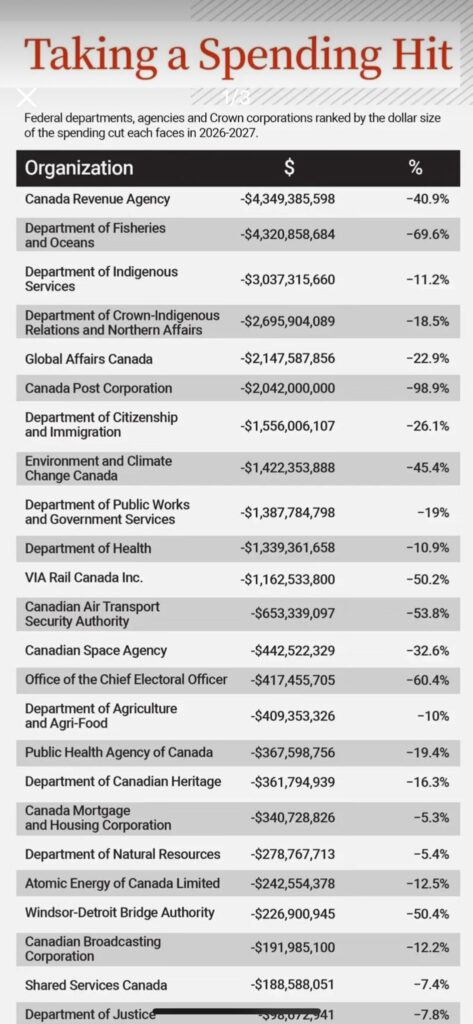
From this findings table, I think this also proves that Canada is focusing more on protecting the country than before. I think it is still not too late, as long as Canada has realized the importance of making sure Canadian citizens are protected and receive the right information from reliable platforms. One more interesting thing I have noticed in Canada is that people cannot see BBC News on social media. I think there must be a reason why, and that also makes me curious.
I like that the speaker provided some examples of how parties use social media or AI to influence people when they have to pick a side. Digital tools can be used to manipulate public opinion in subtle ways. For example, the speaker mentioned that some parties use WeChat and fake images meant to damage political reputations.
As a student or a citizen, we also need to be aware of how to choose what information we can trust. I think choosing reliable sources and making sure we have checked whether the information is real before trusting it is very important.
In this week’s reflection post, I will be focusing on the topic of critical thinking. The speaker mentioned that critical thinking is not just an academic skill; it is also a skill that people can use in their daily lives.
I would like to quote the speaker’s speech: “When people have critical thinking, what makes them believe in something?”
When I apply the speaker’s point to today’s life, I personally think that critical thinking is one of the most important and useful skills for everyone. In today’s society, AI has a huge impact on people’s daily lives. AI has made people’s lives more convenient and more efficient, but at the same time, AI is too powerful, and it can create a lot of fake videos, images, or information for people.
In the video, the speaker mentioned “emotional reactions” and how they have affected people’s beliefs. Therefore, critical thinking has become a useful skill that can help people decide whether information is trustworthy and reliable. It is important to think carefully after you have received some information, and this can help you learn better.
I really like this question that I read from an academic article. I think it has helped me improve my learning a lot.
"Is a learning outcome about critical thinking a matter of emancipatory empowerment or a matter of scientific reasoning? Is critical thinking about finding as a basis for reliable judgements or about forming a sceptical position?"
On the other hand, I really like the gorilla experiment, which showed that people can easily miss obvious things because they are focused on something else. When you apply this to people receiving messages online, it can lead them to believe wrong information due to carelessness.
Therefore, I believe that critical thinking can help us a lot in our daily lives, and we have to stay calm and make sure we have checked whether the information is reliable and trustworthy.
Erikson, M. G., & Erikson, M. (2019). Learning outcomes and critical thinking – good intentions in conflict. Studies in Higher Education (Dorchester-on-Thames), 44(12), 2293–2303. https://doi.org/10.1080/03075079.2018.1486813
In today’s topic, I will focus on what changed in education in 2020. I personally think that this year was the first step in changing education. I would say 2020 became a milestone for education, exposing the outdated nature of traditional learning approaches. Since then, people have sought new methods of teaching and learning to help students succeed under different circumstances.
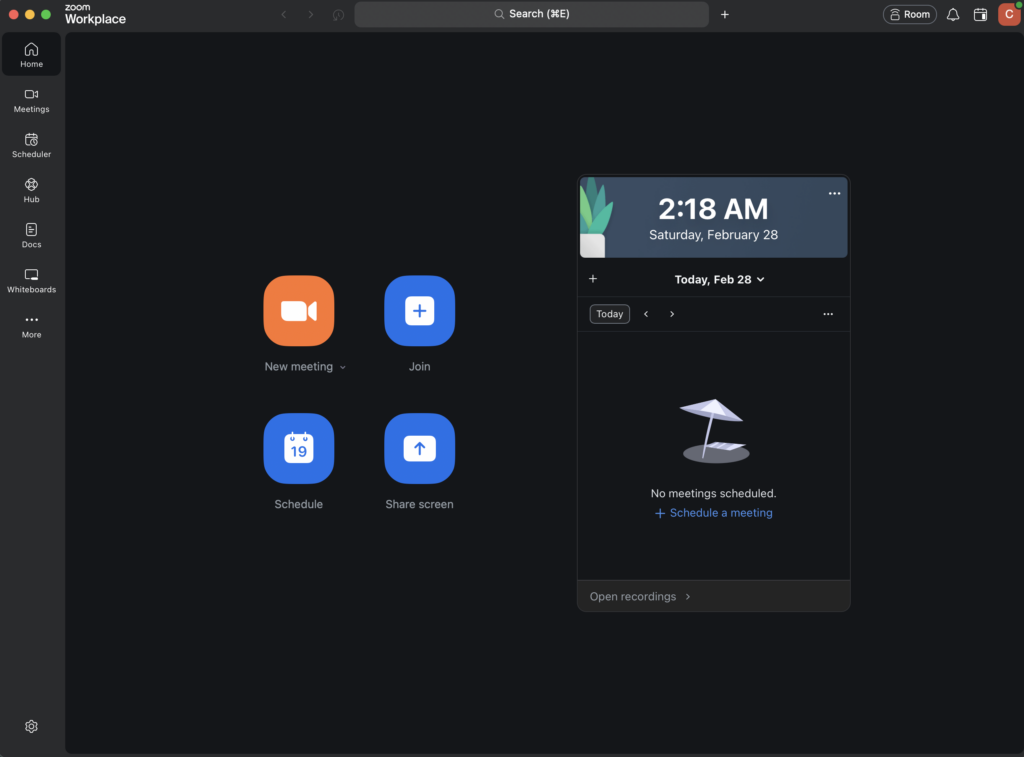
The COVID-19 outbreak in late 2019 led to social distancing, and the government rolled out restrictions. People could not go to school due to COVID-19. Everyone panicked, not only because of the virus itself, but also because students could not study the way they used to. In 2020, online learning and online lessons became common around the world. Students used Zoom to learn and participate in class. Therefore, in today’s topic, I would like to talk about Zoom and the benefits of learning online.
Zoom is one of the common apps that students will use in 2020. We use this app to participate in class.
I think it will be a good idea to use Zoom to record, since Zoom has become one of the most common tools students use to participate in class. Students are able to study more flexibly. It has expanded the possibilities for learning. Learning is no longer limited. Students can study or join class even from a different country. Furthermore, they are able to study or attend lessons in a comfortable environment.
Moreover, Zoom gives students more flexibility with time; they can schedule meetings with their classmates at times that work for them.
Last but not least, Zoom allows teachers to save recordings. Even if students miss a lesson for personal reasons, they can still watch the recording after class.
The benefits of online learning
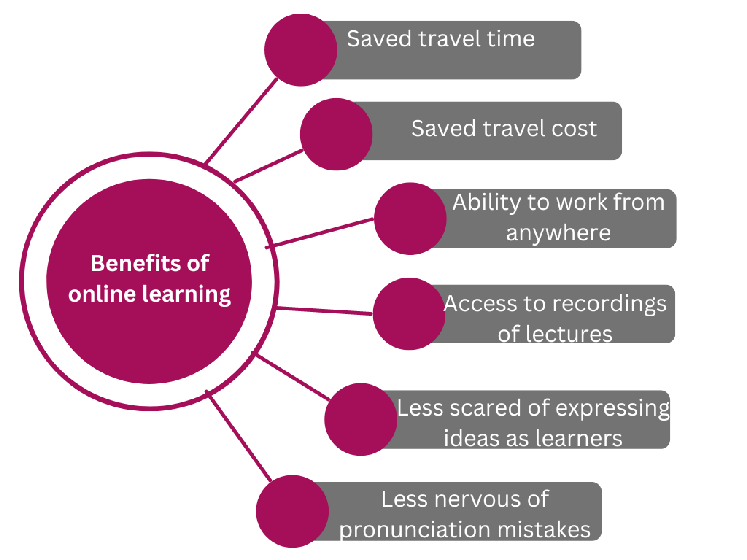
I think tools such as Zoom have broken the limits of learning. Students are no longer limited in how they learn. Therefore, online learning has provided many benefits to students, such as saving travel time, reducing travel costs, allowing students to study where they feel comfortable, and learning at times that work for them.
I would love to share this quote. Online learning, according to Latchem (2014), “ceases to be mere delivery of digital learning products for the students’ consumption and becomes a platform whereupon knowledge and learning are created by students through interaction, collaboration and inquiry” (p. 311).
Social media has become one of the most useful tools for learning. Therefore, I believe social media platforms like WordPress can serve as supplementary tools to help students maintain their learning progress. Students can post their feedback and learning progress throughout the semester.
This approach breaks away from traditional teaching models, integrates more diverse educational strategies, and can enhance students’ enthusiasm for learning.
Students have the freedom to manage their own learning time and actively manage their learning process. Teachers provide support to all members through group meetings. Students can discover more interesting knowledge through peer interaction, and when encountering difficulties, they can exchange ideas and learn from each other. Therefore, I believe 2020 was a significant milestone in the development of the education system.
I think this will be an interesting topic to explore. Education across 19 countries was quite similar until 2019. After 2019, education methods, styles, and systems changed significantly. Before 2019, I would say most education remained the same. The main difference across these 19 countries was that people mainly received knowledge from textbooks or teachers. In the early 20th century, people were able to learn online through computers. But after 2019, education changed a lot. This term, I will discuss changes in education before 2019, in 2020, in 2021, and the future of education. In today’s topic, I will focus on education methods before 2019.
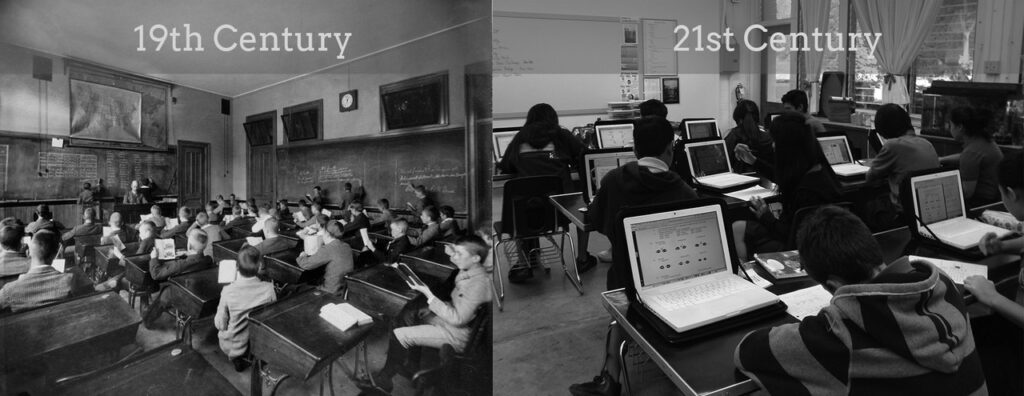
Looking back across 19 countries, I have noticed that educational systems and teaching methods have changed a lot because computers and online learning have become more common in people’s daily lives. Students can easily access technology and the internet to support their learning. Therefore, I would say that in the past, we mainly learned through textbooks or teachers but times has changed.
The education system at the beginning of the 21st century has changed compared to the 19th century. While students still learn in classrooms, they can now explore knowledge online, not just through teacher lectures. Therefore, Universal Design for Learning (UDL) provides students with multiple ways to access knowledge and engage with learning content. Providing flexible learning methods enables learners to thrive in cyberspace. This optimizes learning efficiency and supports students in different contexts.
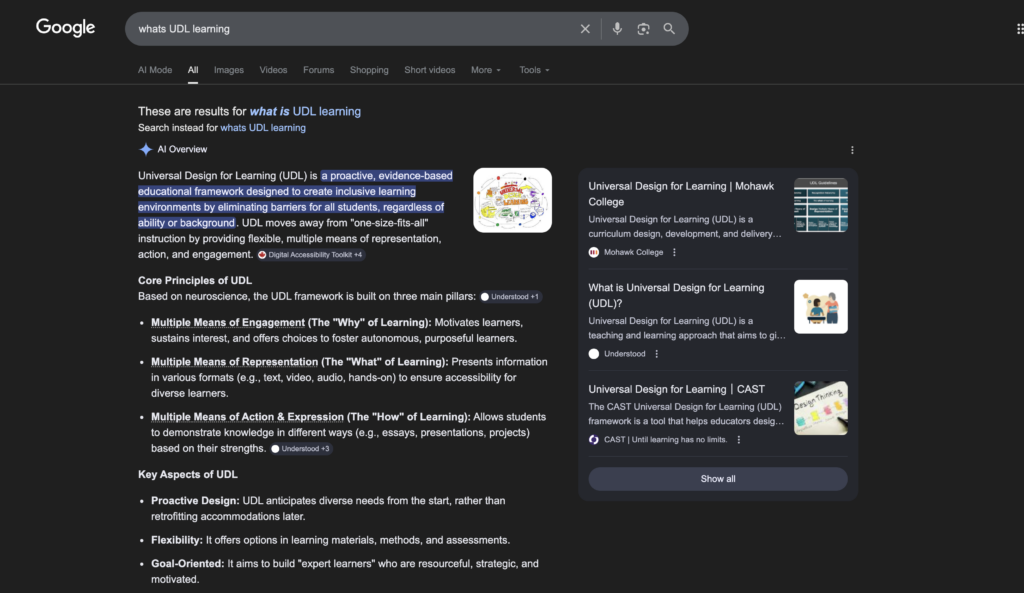
Google is one of the tools I often use when I am dealing with theory or concept questions. Google has a huge database, so students can search for any theoretical question or concept they are unsure about. This makes Google a great tool for self-learning.
For example, when I am confused about what UDL is, Google can provide the concept of UDL. As a result, this can help students learn more effectively and support self-learning. Students can look it up online and find the answer. This is much more effective than looking in a textbook and not knowing where to find the information. The only thing to be aware of is that some online information might be misleading or incorrect. Therefore, finding answers on a reliable website is an important factor that helps students learn.
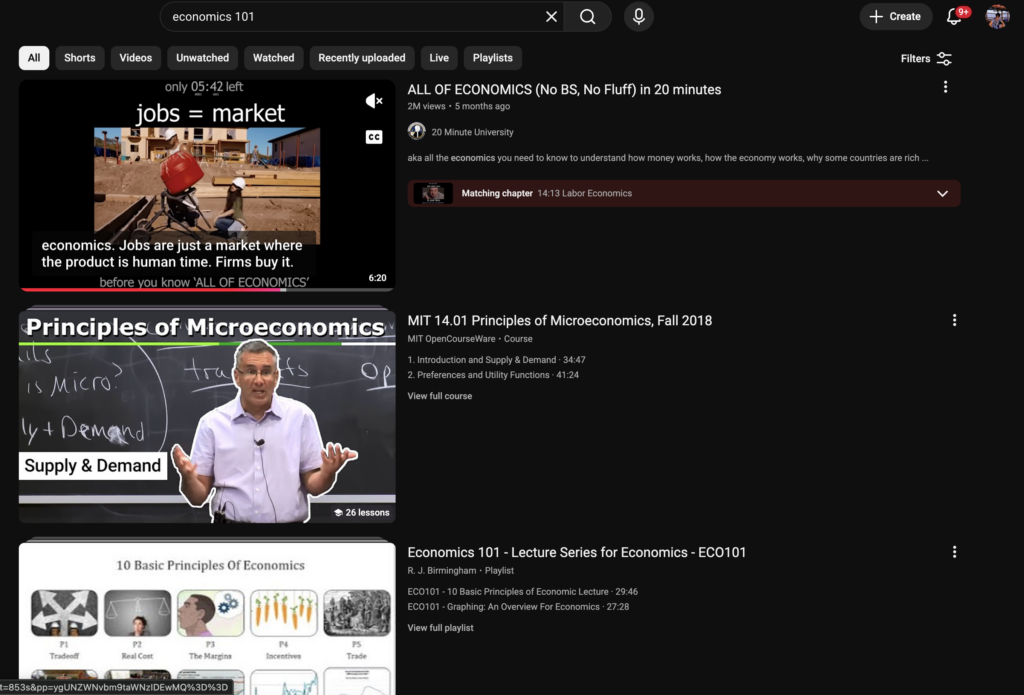
As an economics student at UVic, I use YouTube as a tool to help with learning. Sometimes, when I face a concept I don’t understand, I use YouTube. The biggest difference between YouTube and textbooks/notes is that, by watching YouTube, you can learn through video. The person in the video can walk you through the whole question step by step. This is a very useful tool when you are dealing with mathematical questions, because you can work on the question at the same time while watching the video. This can be very useful and effective for learning.
This means students can choose the best platform that works for them. Moreover, it also means that learning through different pathways has extended far beyond the four walls of the classroom. Each layer strengthens the others, turning a simple posting exercise into a richer cycle of learning experiences.
Students can build knowledge through their peers, instructors, or even by learning from others on different platforms. These platforms have played an important role in the learning process. Combining these factors can help students achieve a deeper and more effective learning experience. I believe students learning through these different platforms is a great example that combines social, teaching, and cognitive elements.
In this reflection, I will focus on the speaker’s speech and an article I found. I think he pointed out some ideas that inspired me to think about academic surveillance in higher education. This is a significant issue since AI has made academic surveillance in higher education even more challenging.
Therefore, I would like to point out that his argument “AI proctoring functions like mandated spyware, collecting webcam, microphone, and browser data and flagging “abnormalities,” which can turn learning into a cat-and-mouse relationship.”
I think this will be an interesting topic to discuss, since OpenAI was created in 2015 and AI has improved significantly every year. I personally think AI can be a great tool, but it can also be harmful to learning. Rather than focusing on cat-and-mouse game, I would like to focus on the advantage and disadvantage using AI in education.
The advantages of using AI in learning:
As university students, we often face different concepts and questions that we are not sure about. AI can be a great tool to help us find answers more easily and understand questions faster. Therefore, it can make learning more cost-effective.
Moreover, I also think AI can raise academic standards and educational quality. AI can be a great teacher, and users can ask any questions they have. This can help students learn by using AI.
The disadvantages of using AI in learning:
However, some students use AI in the wrong way. They use AI to do their homework or write papers, which can cause issues such as academic dishonesty.
Moreover, it can raise further concerns about whether the education level is reliable, since students can use AI to complete their papers and homework. Therefore, companies might question whether people who graduated after 2021 actually have the ability that matches their education level, or whether they were just using AI. I think this is a huge issue we need to focus on.
Overall, I believe using AI in the right way can help you learn more effectively through self-learning.
In this recording, a senior university IT leader shares her ideas and explains why cybersecurity is a core part of digital literacy. The speaker also describes her role and how she uses IT in her daily work life. She has also participated in government cybersecurity.
I think she shared many good points, and this is really meaningful. For example, she points out that digital citizenship is an important factor that students should be aware of. Therefore, Wency mentions that students should protect their digital identity and data, and build this as a habit. They should understand that they need resilience against cyber threats so they can protect their online identity. Moreover, Wency also mentions that students need to take responsibility for their online behaviour.
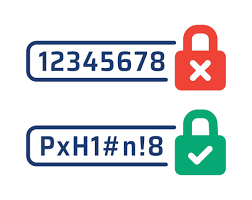
I think one of the important things she points out is how AI impacts people’s lives. Due to AI, cyber threats can involve more believable deception. People may find it hard to realize whether something is real or fake. Therefore, people should be more aware of what they see online. Students should take actions to protect themselves online. For example, they should make sure their software is updated and avoid reusing passwords.
Moreover, I think using a VPN is a good idea to protect your personal information. VPN can stop third parties from seeing which websites you visit or what data you send and receive online. By reading the article below, I found out that a VPN is one of the best tools that can effectively protect your digital citizenship on the internet.