EDCI 337: Multimedia Challenge – OER
Topic: Managing money as a student: tracking expenses, saving tips, common traps
Updated: March 16, 2026
Authors: Himson Chu, Parsa Peikani
INTRODUCTION:
In today’s society, people admire materialism, and students can easily fall into common consumer traps and develop incorrect consumption habits because they have never received formal instruction on budgeting, tracking spending, and avoiding financial mistakes. Even though money management is an important skill, students can hardly learn it in school, and these skills have often been overlooked. In order to help students avoid overspending, relying too heavily on credit, and struggling to save, this learning model is designed to help students spend and use their money wisely and recognize common spending traps before they become bigger problems.
The goal of this resource is to establish a correct concept of consumption. We have designed a learning model that can help students use and save their money wisely, which is relevant to student life. Therefore, in this learning model, we aim to make the learning process an easy-to-understand and engaging resource for students by incorporating multimedia, interactive elements, multimedia learning theories, active learning models, accessible online content, and universal design for learning strategies, so that learners can eventually apply the content to their own lives.
DESCRIBE THE CHALLENGE:
University is often the first time students have real control over their own money—and it can feel overwhelming fast. Tuition, rent, groceries, transportation, and other entertainment activities can eat up a student’s entire income. Meanwhile, peer pressure, fear of missing out, and “treat yourself” culture make it easy to overspend without noticing.
Our website design responds to the challenges that students may face. By giving them a step-by-step guide to understand and use the tools on the website daily to manage their money more easily.
CONTEXT AND AUDIENCE:
The primary audience will be freshmen and sophomore undergraduate students living away from home for the first time on a tight budget. They’re navigating dormitory life or first off-campus rentals, dealing with newfound freedom, and feeling the pressure to keep up socially. This topic connects strongly to students’ lived experiences, such as rental, food expenses, online shopping and credit carding
Due to this resource, the target audience will be above 18; therefore, we will include more specific terms and skills that can actually help them in real life. Furthermore, in order to help university students apply the knowledge from the learning model, we have created different trackers that can help students apply their knowledge to different concepts. These tools will be useful, and they may use them at any time.
In order to support learners with different needs, the resource uses:
- plain language
- short sections
- visual examples
- step-by-step tasks
- practical scenarios
POV STATEMENT:
Students should develop good financial habits, which is a practical and easy-to-understand financial management method. This can help them manage their spending, use their money wisely, and avoid common financial mistakes.
LEARNING OBJECTIVES:
By the end of this resource, students will be able to:
- Identify and categorize their income and essential vs. discretionary expenses.
- Monitor and record daily expenses using simple digital tools.
- Identify 5 common budgeting traps specific to students.
- Apply practical saving techniques such as 50/30/20 rules.
- Design and create a personalized monthly budget template.
In this learning model, students may take away the knowledge they have learned from this learning process. After completing the model, they can still use the tools to help them manage and use their money wisely.
Plan (Ideate, Sketch, Elaborate)
IDEATION:
IIn the planning process, our model focuses on the real financial challenges that students may face in their daily lives. We have developed a well-organized website for students with different needs to access. We have six different modules on the website, including quizzes, tools, text, videos, and images, which can help students learn even if they have different needs. After completing the tasks, they will also receive feedback from the website, which will provide suggestions on how to use their money wisely.
The model includes:
- Explore common financial challenges students face
- Spending examples of collecting realistic student data
- Including some of the relatable examples, such as coffee spending, food delivery, subscriptions, transport, and shopping
- Design interactive activities
- Create a simple budget tracker tool
- Student will some feedback once they have upload their expenses tracker
Those ideas and thoughts have helped us create a website with a written introduction and informative videos on how to manage money. The goal of the tracker is a formative check-in to ensure students understand. The summative task is to help students track and manage their money wisely. Students may upload their tracker to see their expenses and receive feedback from the website or analyze them.
STORYBOARD OR SCRIPT
The website is an easy-to-access tool for students to learn and apply the knowledge they have gained.
On this website, we have included different features for learners. We aim to help students understand and apply the knowledge in their daily lives. On the website we have included five different modules:
1.Income vs. Expenses
- Students learn where money comes from and where it goes.
2. Track Your Spending
- Students can use the interactive budget tracker to input their different spending and build awareness of where their money actually goes.
3. 5 Budgeting Traps
- Students will be introduced to the five common traps that can stop them from saving money, such as procrastination, subscription creep, emotional spending, credit card overuse, and social pressure.
4. The 50/30/20 Rule
- This model introduces a simple budgeting framework that divides income into needs, wants, and savings. This teaches students a simple rule for spending their money.
5. Build Your Budget
- In the last section, students will use all the knowledge they have learned from this model and enter everything into the model. This will be a very useful tool for students to actually use and apply the knowledge in their real lives.
6.References and Resources
The module is built step by step and helps students work through different concepts and tasks. We have included some everyday solutions to help students better understand the content.
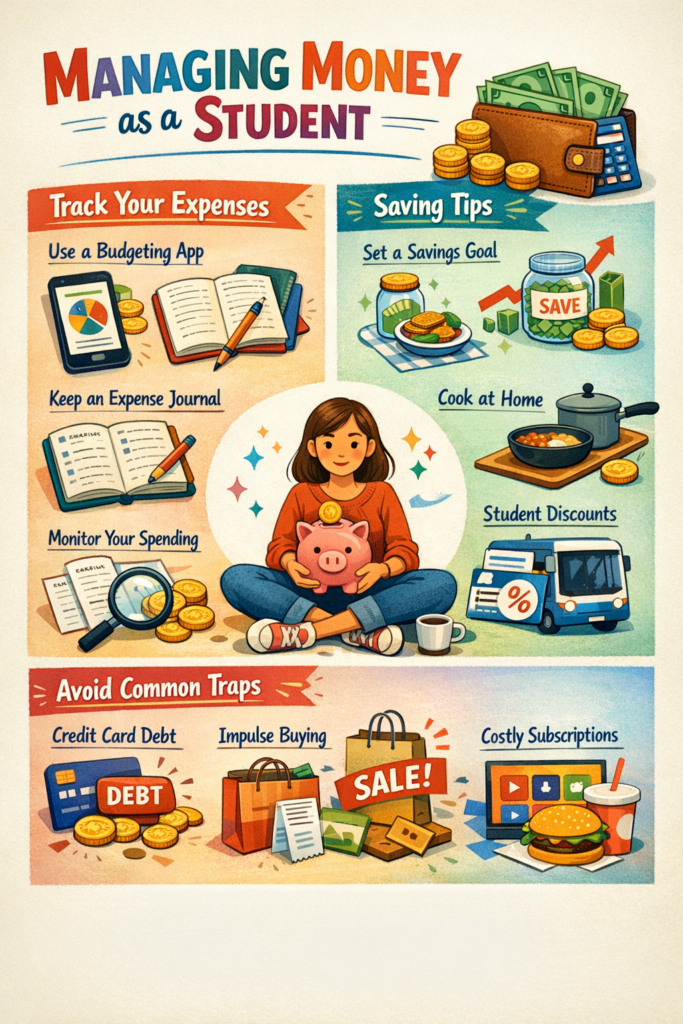
Since managing their own expenses and applying the 50/30/20 Rule involves a lot of math, we have designed a tracker. Students only need to enter the numbers, and the tracker will help them do the math and provide basic advice.
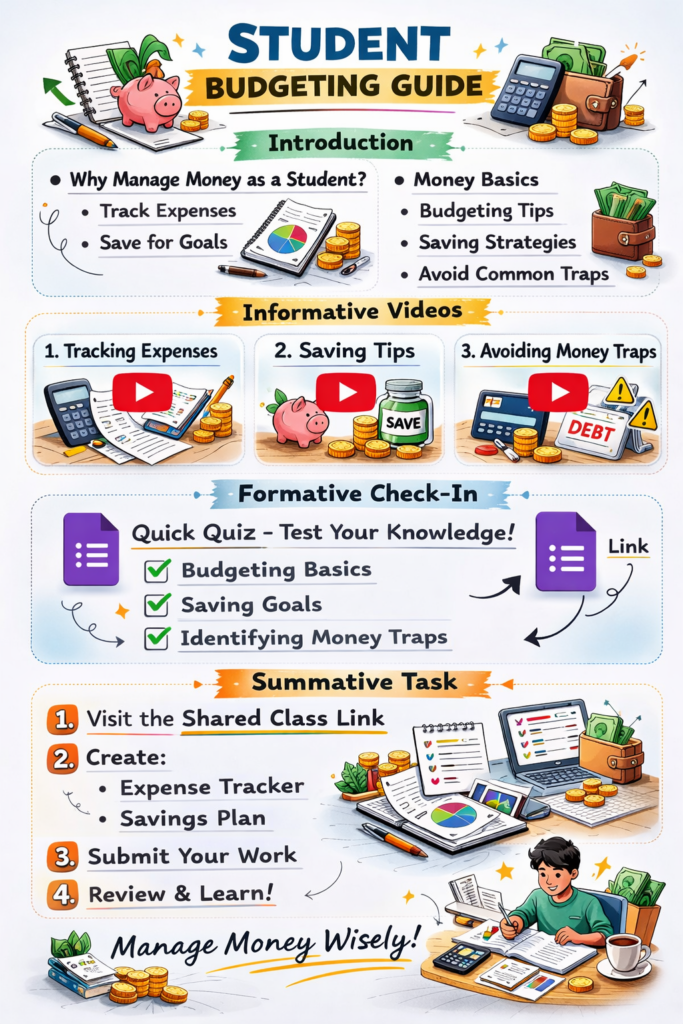
PEER FEEDBACK:
The thing that came up the most in terms of strengths was that the topic is very strong, relevant, and easy for students to connect with. The topic focuses on a common issue that students may face when they are living by themselves in college. They have to live independently and manage their money on their own. This can be very challenging for students since they may have never lived by themselves before going to college. Therefore, the feedback mentioned that my learning objective is clear, engaging, and realistic. They also highlighted that the tools we created are very useful for students when it comes to managing their money. Since we not only provide students with concepts and knowledge but also give them a chance to apply that knowledge, this will help students in the learning process.
They also mentioned that we have applied theories well on the website and that it has a good mix of visuals, text, activities, and real-life examples, such as rental expenses and other daily expenses. They found the tools very useful for students who have difficulty managing their money. In the project, the website connected well with learning theories such as Accessible Multimedia, UDL, and Merrill’s real-world learning. Students may apply their knowledge in their real lives after learning from the model.
The biggest area for improvement that both peers pointed out is that the website needs more visuals because it is too text-heavy and looks too “informative.” Therefore, we have included more images, tables, and quizzes to help and test students after each section. Therefore, we made some changes and restructured the pattern in the final design for the website. The latest version of the website will provide clear, simple text, images and a well-organized website that will provide a better learning experience for students.
REFLECT AND REFINE:
The things that worked best on the website were its strong use of constructivism and learning by doing. On the website, different modules have different tasks and quizzes that require students to complete them. Through these tasks and quizzes, students may strengthen the knowledge they have learned. Furthermore, both pieces of feedback confirmed that we have a strong structure that guides students step by step through the learning process. Therefore, based on this feedback, we kept the same structure in the new version of the website.
On the other hand, based on the feedback, we made several revisions. One thing that needed improvement was that we used too much information and text on the website. Since extra material adds extraneous cognitive load and should be removed (Mayer, 2009), we removed some of the text and replaced it with images and quizzes. This helps students learn and check their understanding during the learning process. The model guides students step by step, and the website has been restructured to include videos, quizzes, and different texts to help students learn. Furthermore, this allows readers to learn through both visual and verbal channels (Paivio, 1986). The model structure also follows the segmenting principle by presenting the message across different modules (Mayer, 2009).
Lastly, in order to increase interactive elements, we added quizzes and additional reflection activities that would engage learners more. After they submit the tasks, feedback will be shown, including which areas the students need to improve in each module. In conclusion, this was a great experience that helped us understand how important open educational resources are and how to design a website for students with different needs. The feedback provided us with valuable advice that helped us improve the website and provide students with a better learning experience.
The website before the feedback:
https://parsapeikani.github.io/student-budget-guide/index.html
After reviewing the feedback, here is the link to the website:
https://parsapeikani.github.io/student-budget-pro-guide/index.html
THEORIES APPLIED:
Universal Design for Learning (UDL): Employing a variety of presentation methods (visual and textual) to stimulate participation (related things that students may see in their daily lives) and support expressive methods (which can motivate students to learn more in depth).
Constructivism / learning by doing: From the website, students may apply the knowledge they have learned, such as using budget trackers, entering their income, and adding their expenses. It can help students create their own personalized monthly budgets. These activities can help students build understanding through practice.
Accessible Multimedia:
The website uses simple text, images, videos, and clear page organization. This will make the content easier to follow and create a better learning experience for students.
Web Content Accessibility Features:
- Use videos to help students learn.
- Use simple and easy-to-understand language, and avoid unnecessary jargon.
- Ensure sufficient contrast between the text and the background.
- Use organized tables to help students read the content.
- Use table sections to help students learn the concepts.
- Use images to help students learn and receive the same information when they have different needs.
Cognitive Load Theory:
In one of the model’s 50/30/20 rule pages, learners are shown some examples and then required to test their knowledge. This is a “demonstrate first, then practice” approach.
Scaffolding :
In the model, we have created a step-by-step guide to lead learners through the process. In the beginning, we have the introduction, then the quiz, and then different tasks that we would like students to complete. At the end, students need to use everything they have learned and apply it in the last section. It will be a useful tool that students may take away to help them manage their money in the future.
Self-Regulated Learning :
In the model, students will learn different concepts in different modules. After that, they will apply the knowledge by using different tools, such as a tracker, reflection prompts, and a budget builder, which will encourage students to monitor their own behaviour.
TEAMWORK REFLECTION:
In terms of teamwork, I think we divided the work well. We set up regular meetings and had regular check-ins when there were issues or confusion.
I focused on most of the writing for this webpage and helped create one of the budgeting tools on the website. I think I learned a lot by organizing this webpage. I understand that working with others is not the same as working alone. Therefore, I set up regular check-ins and checked the channel often to make sure Parsa Peikani did not have any confusion or questions. I think it was important that we worked collaboratively throughout the process and maintained consistent communication to ensure the project stayed clear and aligned with our goals.
On the other hand, Parsa Peikani is a computer science major, so he created a wonderful and well-organized website that includes different theories such as UDL, Constructivism, Accessible Multimedia, Cognitive Load Theory, Scaffolding, and Self-Regulated Learning. Those factors are important when it comes to designing a website. I think this was very challenging for him since he was the only one working on the website. Therefore, I think this was very challenging for him. Luckily, after all the hard work we did, we overcame all the problems and confusion related to the website or webpage. I think this was a successful group project.
Academic References
AI-Generated Picture
Canadian University Survey Consortium. (2023). 2023 graduating student survey: Master report. CUSC-CCREU. https://cusc-ccreu.ca/
Lusardi, A., & Mitchell, O. S. (2014). The economic importance of financial literacy: Theory and evidence. Journal of Economic Literature, 52(1), 5-44. https://doi.org/10.1257/jel.52.1.5
Prelec, D., & Simester, D. (2001). Always leave home without it: A further investigation of the credit-card effect on willingness to pay. Marketing Letters, 12(1), 5-12. https://doi.org/10.1023/A:1008196717017
Warren, E., & Tyagi, A. W. (2005). All your worth: The ultimate lifetime money plan. Free Press.
Granchelli, A. (2025, November 2). Accessible Multimedia. University of Victoria: Educational Technology. https://edtechuvic.ca/edci337/2025/11/02/accessible-multimedia/
Granchelli, A. (2025, September 5). Theories of Multimedia Learning. University of Victoria: Educational Technology. https://edtechuvic.ca/edci337/2025/09/05/theories-of-multimedia-learning/
Granchelli, A. (2025, October 19). Models of Active Learning. University of Victoria: Educational Technology. https://edtechuvic.ca/edci337/2025/10/19/models-of-active-learning/
Leave a Reply