In today’s topic, I will focus on what changed in education in 2020. I personally think that this year was the first step in changing education. I would say 2020 became a milestone for education, exposing the outdated nature of traditional learning approaches. Since then, people have sought new methods of teaching and learning to help students succeed under different circumstances.
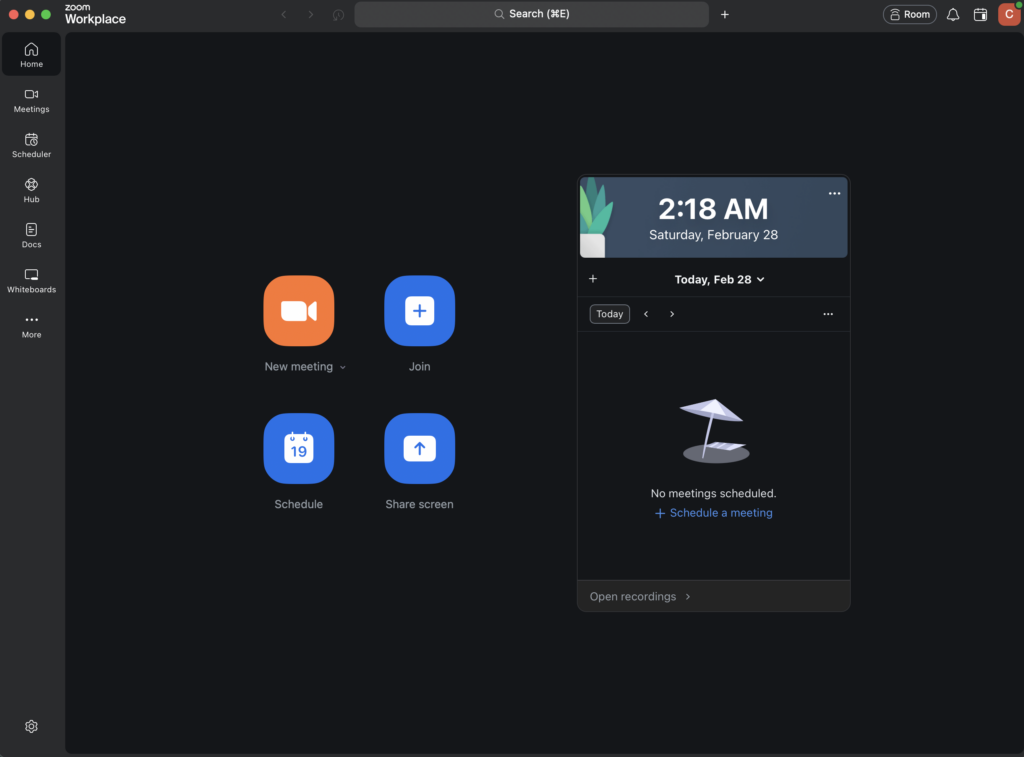
The COVID-19 outbreak in late 2019 led to social distancing, and the government rolled out restrictions. People could not go to school due to COVID-19. Everyone panicked, not only because of the virus itself, but also because students could not study the way they used to. In 2020, online learning and online lessons became common around the world. Students used Zoom to learn and participate in class. Therefore, in today’s topic, I would like to talk about Zoom and the benefits of learning online.
Zoom is one of the common apps that students will use in 2020. We use this app to participate in class.
I think it will be a good idea to use Zoom to record, since Zoom has become one of the most common tools students use to participate in class. Students are able to study more flexibly. It has expanded the possibilities for learning. Learning is no longer limited. Students can study or join class even from a different country. Furthermore, they are able to study or attend lessons in a comfortable environment.
Moreover, Zoom gives students more flexibility with time; they can schedule meetings with their classmates at times that work for them.
Last but not least, Zoom allows teachers to save recordings. Even if students miss a lesson for personal reasons, they can still watch the recording after class.
The benefits of online learning
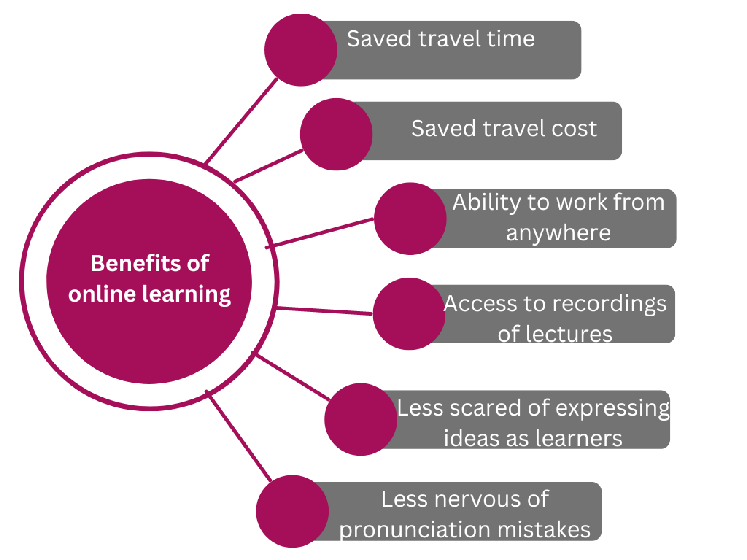
I think tools such as Zoom have broken the limits of learning. Students are no longer limited in how they learn. Therefore, online learning has provided many benefits to students, such as saving travel time, reducing travel costs, allowing students to study where they feel comfortable, and learning at times that work for them.
I would love to share this quote. Online learning, according to Latchem (2014), “ceases to be mere delivery of digital learning products for the students’ consumption and becomes a platform whereupon knowledge and learning are created by students through interaction, collaboration and inquiry” (p. 311).
Social media has become one of the most useful tools for learning. Therefore, I believe social media platforms like WordPress can serve as supplementary tools to help students maintain their learning progress. Students can post their feedback and learning progress throughout the semester.
This approach breaks away from traditional teaching models, integrates more diverse educational strategies, and can enhance students’ enthusiasm for learning.
Students have the freedom to manage their own learning time and actively manage their learning process. Teachers provide support to all members through group meetings. Students can discover more interesting knowledge through peer interaction, and when encountering difficulties, they can exchange ideas and learn from each other. Therefore, I believe 2020 was a significant milestone in the development of the education system.
I think this will be an interesting topic to explore. Education across 19 countries was quite similar until 2019. After 2019, education methods, styles, and systems changed significantly. Before 2019, I would say most education remained the same. The main difference across these 19 countries was that people mainly received knowledge from textbooks or teachers. In the early 20th century, people were able to learn online through computers. But after 2019, education changed a lot. This term, I will discuss changes in education before 2019, in 2020, in 2021, and the future of education. In today’s topic, I will focus on education methods before 2019.
Looking back across 19 countries, I have noticed that educational systems and teaching methods have changed a lot because computers and online learning have become more common in people’s daily lives. Students can easily access technology and the internet to support their learning. Therefore, I would say that in the past, we mainly learned through textbooks or teachers but times has changed.
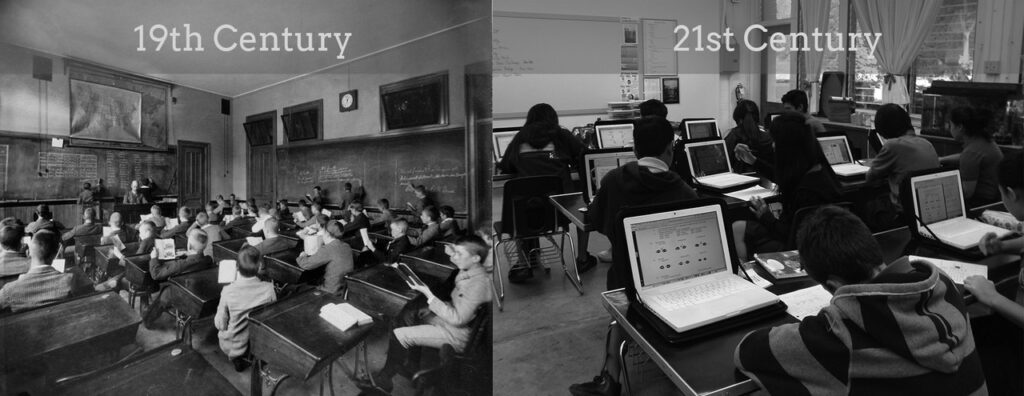
The education system at the beginning of the 21st century has changed compared to the 19th century. While students still learn in classrooms, they can now explore knowledge online, not just through teacher lectures. Therefore, Universal Design for Learning (UDL) provides students with multiple ways to access knowledge and engage with learning content. Providing flexible learning methods enables learners to thrive in cyberspace. This optimizes learning efficiency and supports students in different contexts.
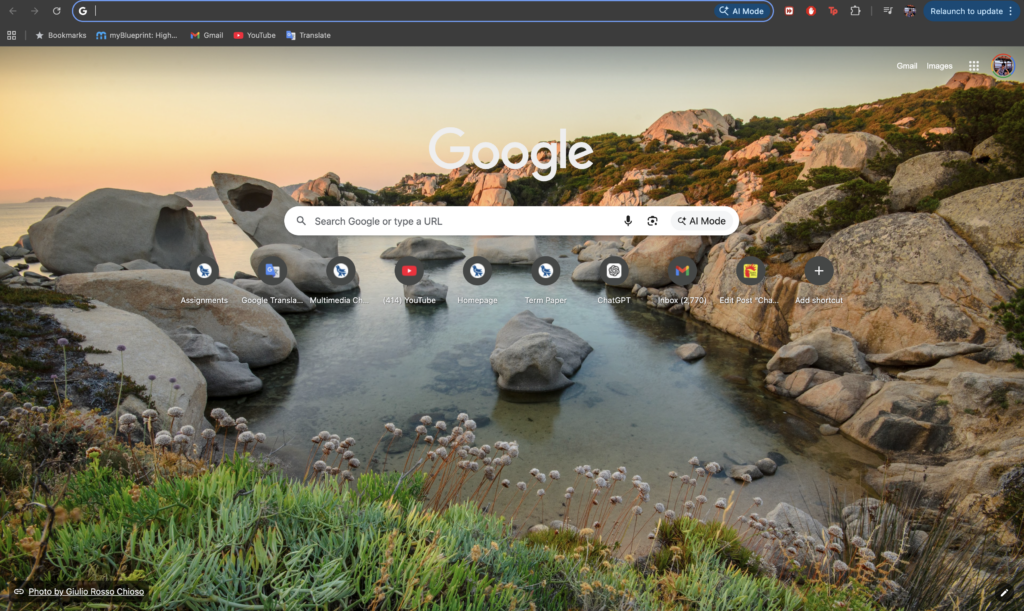
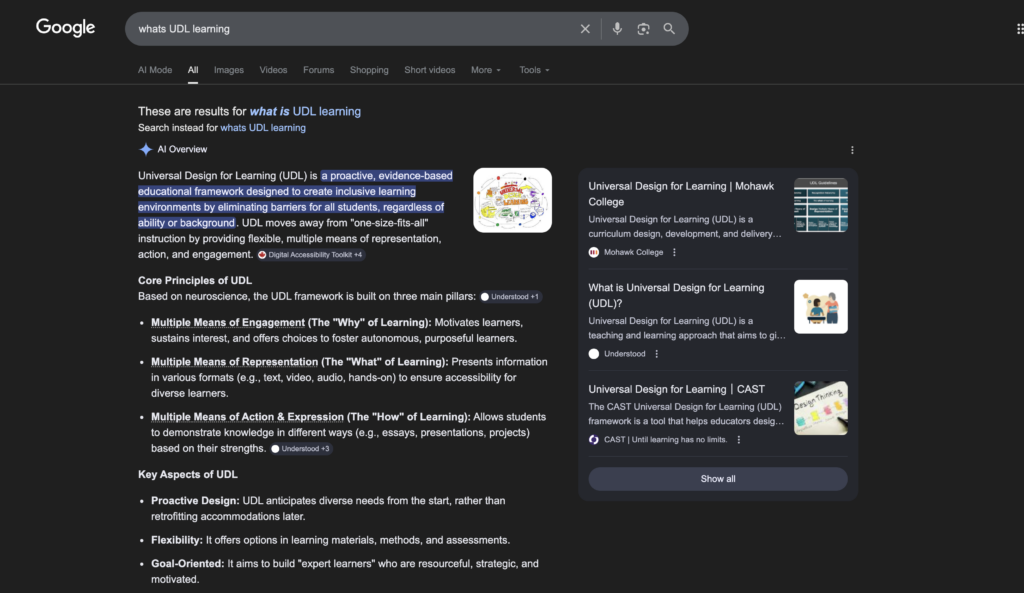
Google is one of the tools I often use when I am dealing with theory or concept questions. Google has a huge database, so students can search for any theoretical question or concept they are unsure about. This makes Google a great tool for self-learning.
For example, when I am confused about what UDL is, Google can provide the concept of UDL. As a result, this can help students learn more effectively and support self-learning. Students can look it up online and find the answer. This is much more effective than looking in a textbook and not knowing where to find the information. The only thing to be aware of is that some online information might be misleading or incorrect. Therefore, finding answers on a reliable website is an important factor that helps students learn.
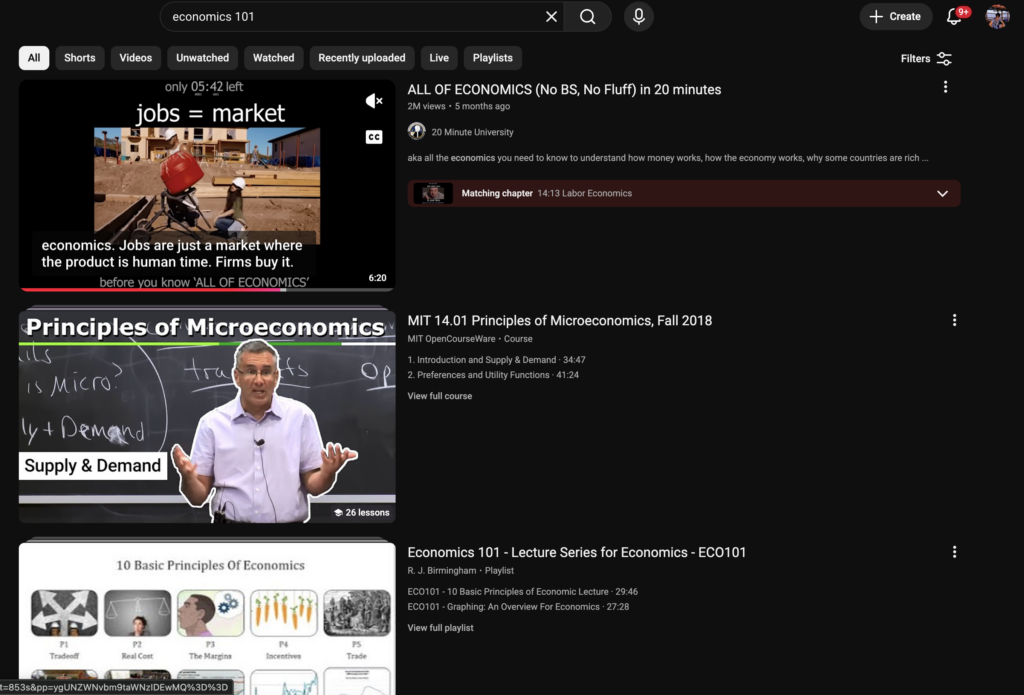
As an economics student at UVic, I use YouTube as a tool to help with learning. Sometimes, when I face a concept I don’t understand, I use YouTube. The biggest difference between YouTube and textbooks/notes is that, by watching YouTube, you can learn through video. The person in the video can walk you through the whole question step by step. This is a very useful tool when you are dealing with mathematical questions, because you can work on the question at the same time while watching the video. This can be very useful and effective for learning.
This means students can choose the best platform that works for them. Moreover, it also means that learning through different pathways has extended far beyond the four walls of the classroom. Each layer strengthens the others, turning a simple posting exercise into a richer cycle of learning experiences.
Students can build knowledge through their peers, instructors, or even by learning from others on different platforms. These platforms have played an important role in the learning process. Combining these factors can help students achieve a deeper and more effective learning experience. I believe students learning through these different platforms is a great example that combines social, teaching, and cognitive elements.
In this reflection, I will focus on the speaker’s speech and an article I found. I think he pointed out some ideas that inspired me to think about academic surveillance in higher education. This is a significant issue since AI has made academic surveillance in higher education even more challenging.
Therefore, I would like to point out that his argument “AI proctoring functions like mandated spyware, collecting webcam, microphone, and browser data and flagging “abnormalities,” which can turn learning into a cat-and-mouse relationship.”
I think this will be an interesting topic to discuss, since OpenAI was created in 2015 and AI has improved significantly every year. I personally think AI can be a great tool, but it can also be harmful to learning. Rather than focusing on cat-and-mouse game, I would like to focus on the advantage and disadvantage using AI in education.
The advantages of using AI in learning:
As university students, we often face different concepts and questions that we are not sure about. AI can be a great tool to help us find answers more easily and understand questions faster. Therefore, it can make learning more cost-effective.
Moreover, I also think AI can raise academic standards and educational quality. AI can be a great teacher, and users can ask any questions they have. This can help students learn by using AI.
The disadvantages of using AI in learning:
However, some students use AI in the wrong way. They use AI to do their homework or write papers, which can cause issues such as academic dishonesty.
Moreover, it can raise further concerns about whether the education level is reliable, since students can use AI to complete their papers and homework. Therefore, companies might question whether people who graduated after 2021 actually have the ability that matches their education level, or whether they were just using AI. I think this is a huge issue we need to focus on.
Overall, I believe using AI in the right way can help you learn more effectively through self-learning.
In this recording, a senior university IT leader shares her ideas and explains why cybersecurity is a core part of digital literacy. The speaker also describes her role and how she uses IT in her daily work life. She has also participated in government cybersecurity.
I think she shared many good points, and this is really meaningful. For example, she points out that digital citizenship is an important factor that students should be aware of. Therefore, Wency mentions that students should protect their digital identity and data, and build this as a habit. They should understand that they need resilience against cyber threats so they can protect their online identity. Moreover, Wency also mentions that students need to take responsibility for their online behaviour.
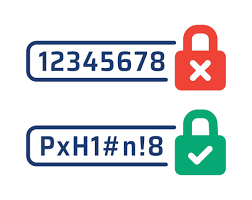
I think one of the important things she points out is how AI impacts people’s lives. Due to AI, cyber threats can involve more believable deception. People may find it hard to realize whether something is real or fake. Therefore, people should be more aware of what they see online. Students should take actions to protect themselves online. For example, they should make sure their software is updated and avoid reusing passwords.
Moreover, I think using a VPN is a good idea to protect your personal information. VPN can stop third parties from seeing which websites you visit or what data you send and receive online. By reading the article below, I found out that a VPN is one of the best tools that can effectively protect your digital citizenship on the internet.
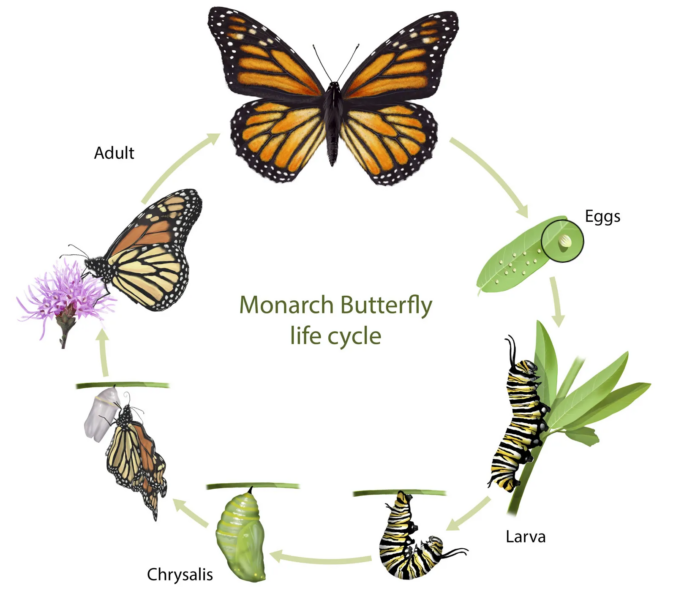
In this model, I will use a story about a butterfly’s lifecycle to help students understand how butterflies have a positive impact on the environment.
I think this topic is interesting and can help students learn more about the environment and how butterflies are connected to it. This is an interesting topic because people usually think of a butterfly as an insect that symbolizes beauty. People often overlook how butterflies have a positive impact on the environment and contribute so much to the ecosystem.
I think this model can help students easily understand things around them and inspire them to see that every animal or insect has value and a reason for being part of the ecosystem. It will help students understand that sometimes we should not only focus on appearance, but on value as well.
THE PROCESS OF THIS MODEL
Understand (Discover, Interpret, Specify)
Help children to know more about butterflies rather just how it looks, teach them how butterflies will impact and connect on the ecosystem.
CONTEXT AND AUDIENCE:
In this educational model, the primary audience is Grades 2–4, which means ages around 6–10. Instead of teaching them textbook knowledge, we should inspire them to learn more about things they might see daily.
To support children in early education, we should encourage them to think more and observe the world around them. Using things that are familiar to them can help them understand more easily and increase motivation and curiosity.
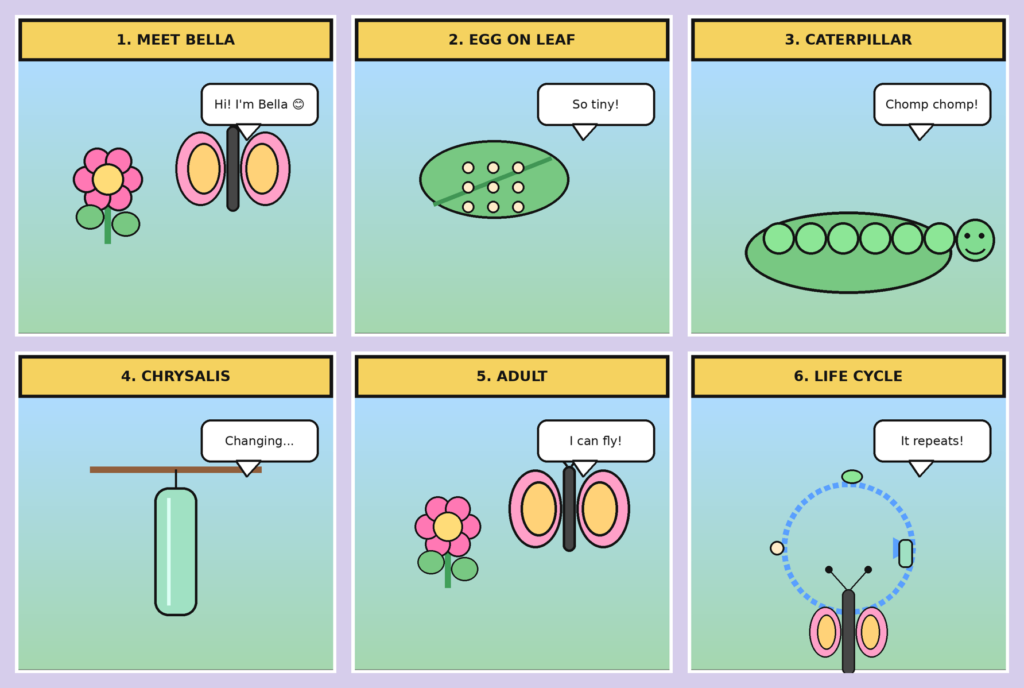
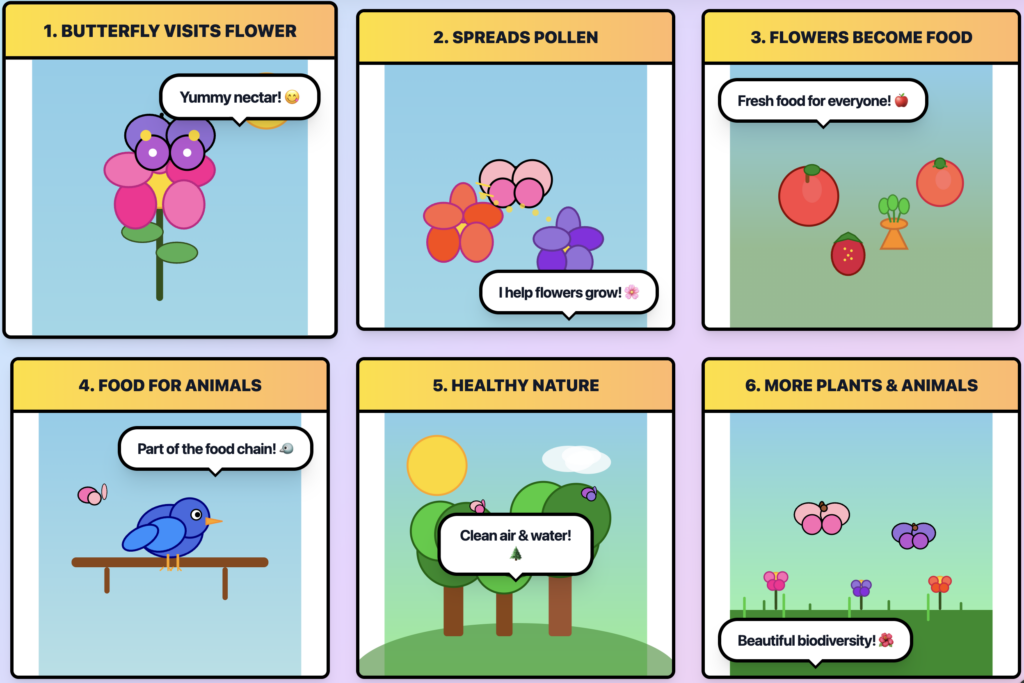
Moreover, because the audience is mainly children in early education, when designing the learning path, we need to be aware of the workload and overall learning design. By using comics and minimizing extraneous cognitive load, simple panel layouts and imagery will help students maintain focus. Therefore, I broke the lifecycle and the ecosystem impact into one stage per comic box.
In order to support students with different needs, I included simple text and images in the comic to help students understand better. Furthermore, considering that Grades 2–4 students can only maintain focus for a short time, the comic was created to be simpler, which can give students a big picture of the ecosystem.
POV STATEMENT:
Primary school students need to learn about the life cycle of butterflies and their contribution to the ecosystem. Therefore, the design of learning objectives and tasks should be low in difficulty, easy to understand, interesting, easy to master, and able to stimulate students’ interest in learning.
LEARNING OBJECTIVES:
Primary Objective:
Students will have a better understanding of each stage of the butterfly lifecycle after reading an educational comic.
Sub-objectives:
Students will have a better understanding of how butterflies contribute to the ecosystem after reading an educational comic.
Students will have a better understanding of why butterflies play an important role in the ecosystem after reading an educational comic.
Students will be able to share their thoughts and ideas with their group after reading an educational comic.
Plan (Ideate, Sketch, Elaborate)
IDEATION:
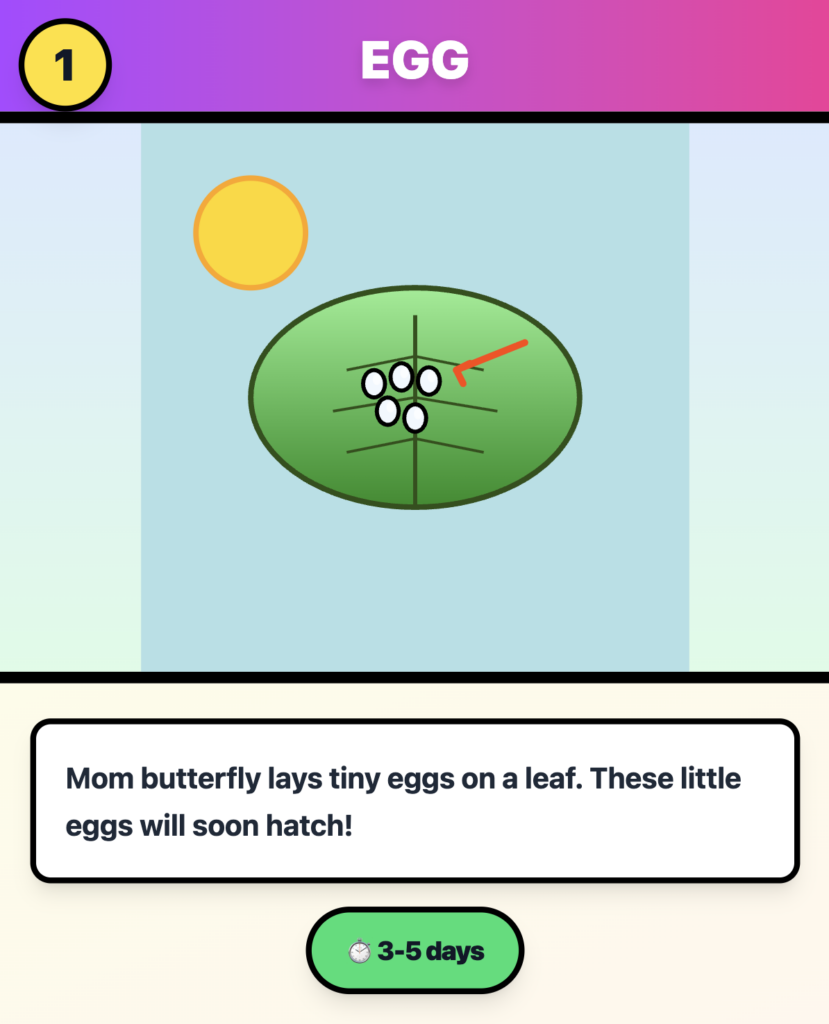
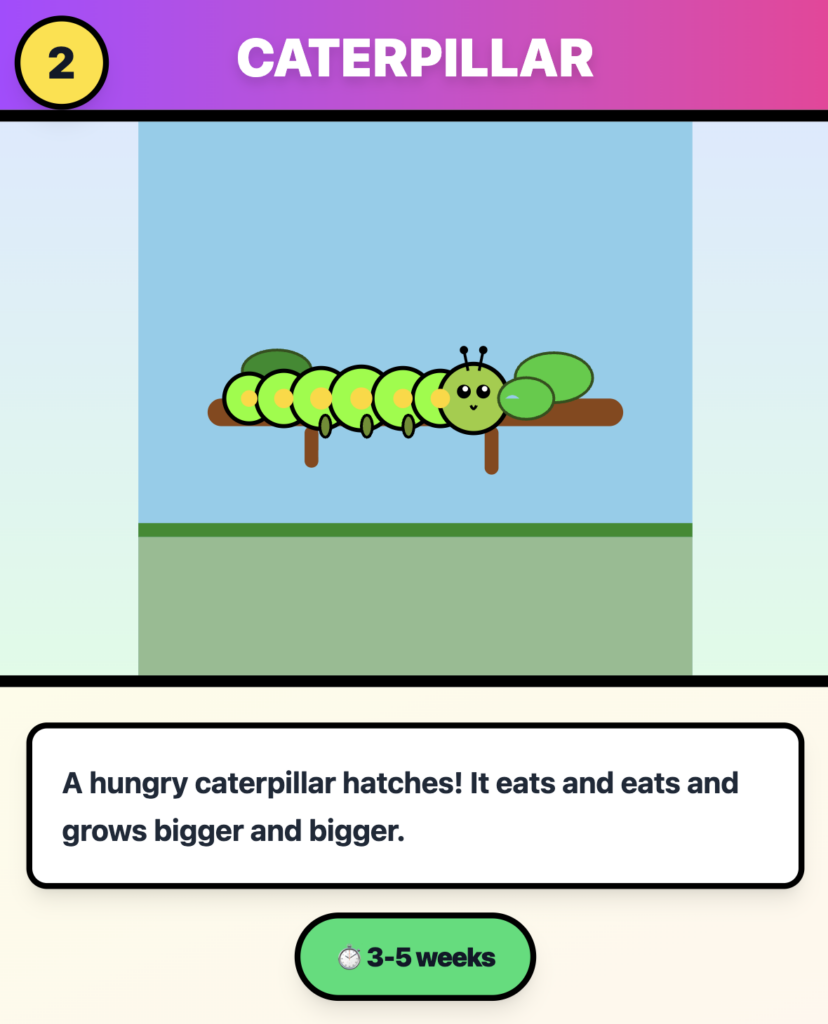
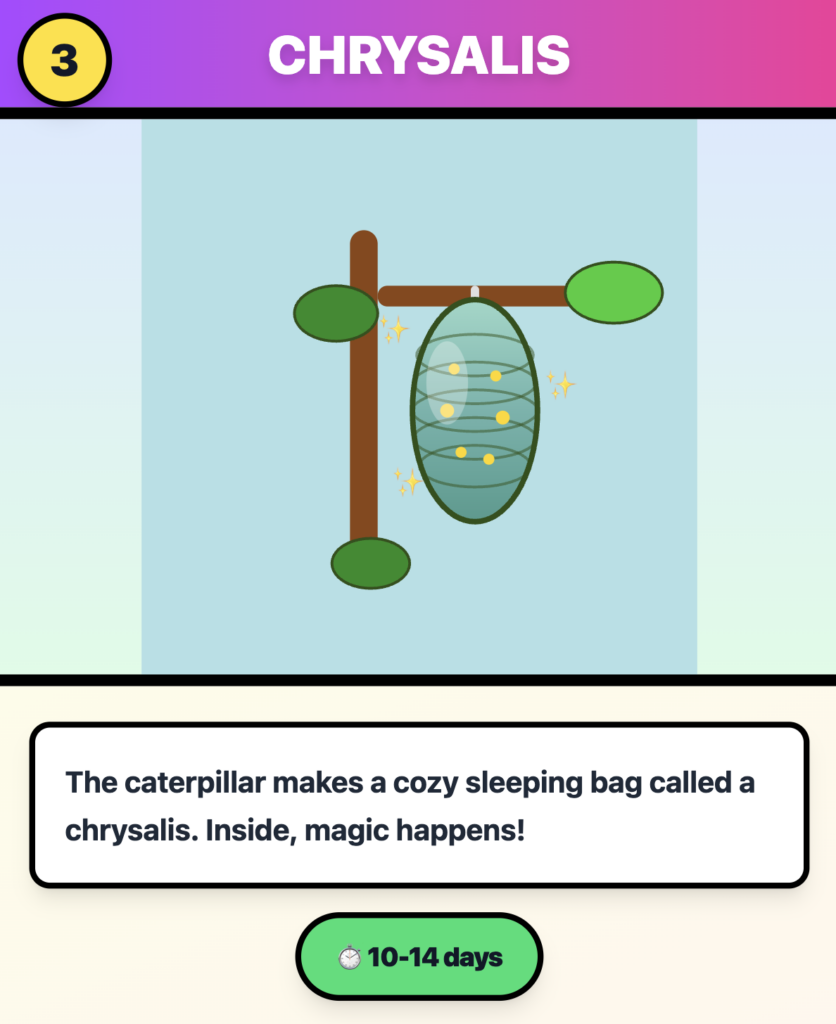
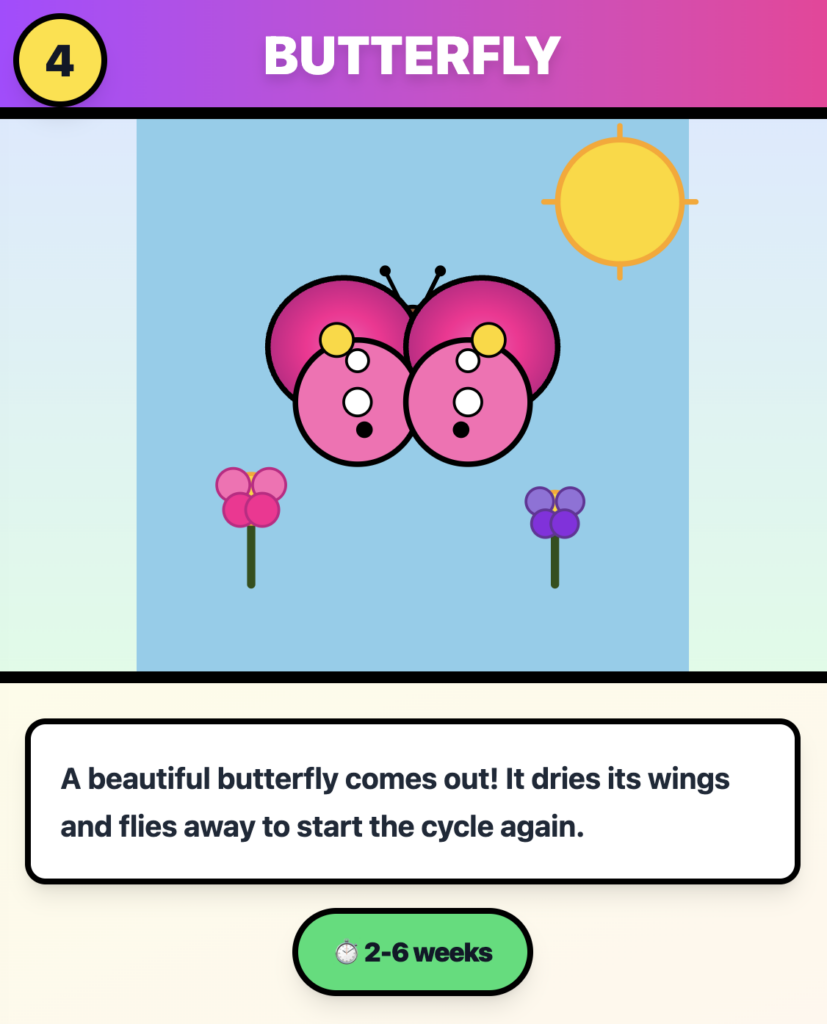
In order to draft my own comic idea, I made two comics about the butterfly’s lifecycle and how butterflies contribute to the ecosystem. I made the text very simple and easy to understand. Because the model targets students in early education, the content has to be designed more creatively, provide the basic idea, and avoid cognitively overloading students. This model will help students see the big picture of the butterfly’s lifecycle and how it changes at each stage. After gaining knowledge of the butterfly’s lifecycle, the next component I included shows how butterflies contribute to the ecosystem, which can help students learn about biodiversity and how things are connected. Therefore, I created two different comics that can help students learn and have a better learning experience.
To avoid a heavy workload and difficulty in understanding, I included only simple and easy text in each comic box. This can help students get a better picture of how the early stages of a butterfly change into an adult butterfly. After helping students develop a better understanding of the butterfly’s lifecycle, the next step is to help students understand how an adult butterfly contributes to the ecosystem. Because each step in the learning process is well designed and connected, this will help students develop a different understanding of this species and learn step by step.
Butterfly impacts the ecosystem: An adult butterfly visits a flower > Butterfly spreads pollen > Flowers become food due to pollen > Animals get food > Nature stays healthy ecosystem cycle > More plants & animals
STORYBOARD OR SCRIPT
Butterfly’s lifecycle
How Butterfly impacts the ecosystem
THEORY APPLIED:
Universal Design for Learning (UDL): Employ a variety of representational methods (visual and textual), stimulate engagement (relatable things that students may see in daily life), and support expressive methods (students can be inspired to learn more deeply step by step).
Multimedia Learning Principles (Mayer): It reduces cognitive load and supports dual encoding by combining text and images.
Accessible Multimedia: I included images and simple text to ensure students can receive the knowledge even if they have different needs.
Cognitive Load Theory: Since the target audience is children in early education, I included only simple text and created images that can help students learn. The model provides a big picture of the butterfly lifecycle and how it impacts the ecosystem. This can help connect the knowledge to their real life.
Merrill’s Principles of Instruction: Throughout the learning process, students may learn about things they often see in real life, but may not have realized the knowledge or value behind them. Therefore, through this model, the new knowledge is incorporated into learners’ world when they reflect on aspects of the butterfly that they admire or respect and share their findings with peers.
PEER FEEDBACK:
The thing that came up the most in terms of strengths was that my comic and model are well designed and age-appropriate for Grades 2–4. In the model, I use simple text and clean panels. I made two different comics: one shows the butterfly’s life cycle, and the other shows how butterflies have a positive impact on the ecosystem. This reduces overwhelm and matches Cognitive Load Theory. In the visual design, I use a consistent layout and uncluttered panels, which help readers keep their attention on the main idea. In the project, I connected well to learning theories such as Multimedia Learning, Accessible Multimedia, UDL, and Merrill’s real-world learning. Students may apply their knowledge and understanding of butterflies and pollination to nature. The second comic adds depth by showing cause and effect. It goes beyond “butterflies are pretty” to “butterflies matter.”
The biggest area for improvement that both peers pointed out was that I could create stronger connections between the two comics. Moreover, they also noted that I could make the butterfly in the comic more beautiful, which could help students have a better learning experience. Therefore, I made some changes in my final design. I recreated the comic to be more interesting and added stronger connections between the two comics. I believe these changes will help students learn and focus on the message that I would like to highlight.
Reflect and Refine REFLECTION:
The things that worked best in the prototype were that I used simple and clean text, since extra material adds extraneous cognitive load and should be removed (Mayer, 2009). Both peers confirmed this. However, they also thought that I should add stronger connections between Comics 1 and 3 and create more beautiful and interesting images to help students stay focused on the model. This would better support the coherence principle.
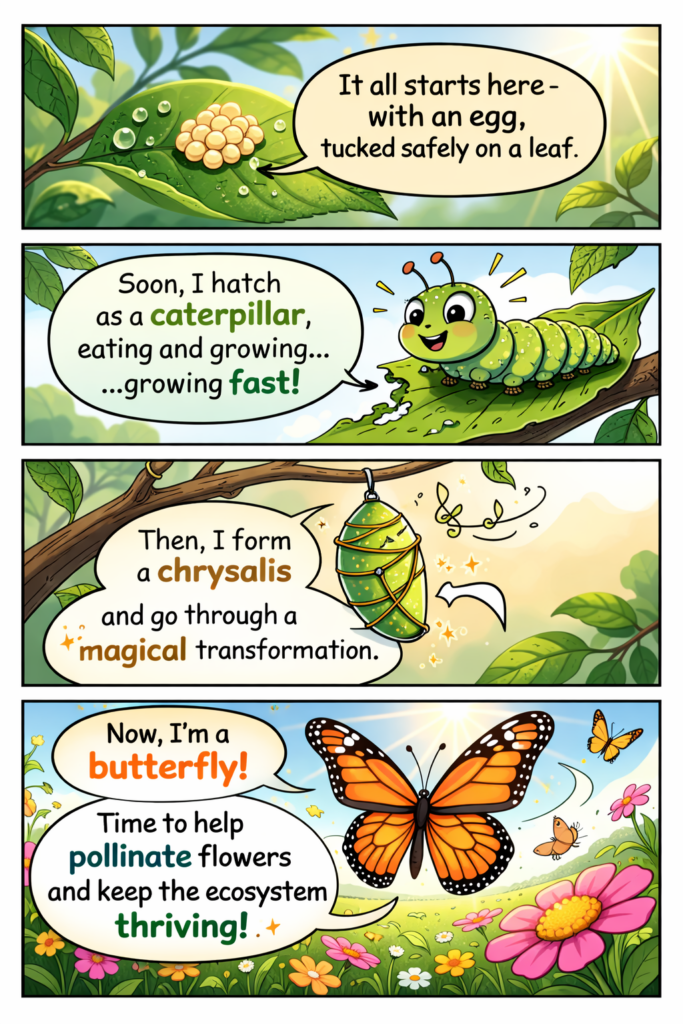
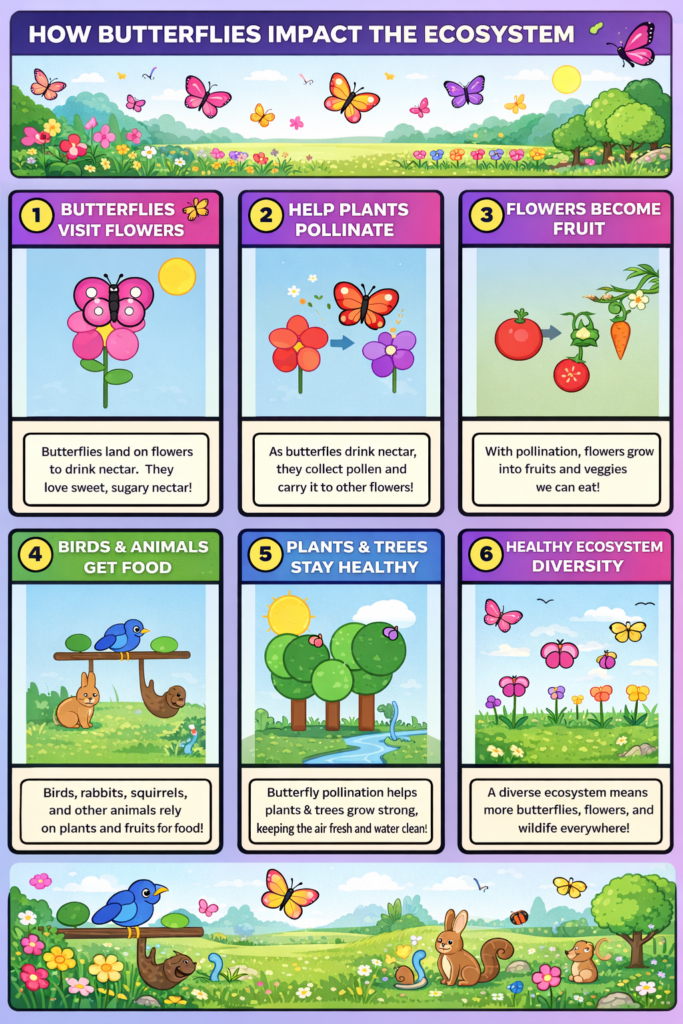
Therefore, based on the feedback, I made several revisions. In the first comic, I used four panels to introduce the butterfly’s life cycle. This provides students with a basic understanding of how the butterfly changes shape at each stage. In the second comic, I used a more interesting style to help students understand what has changed in the butterfly and to strengthen the connection between Comics 1 and 3. In the last comic, I recreated the images to make the butterfly more visually appealing and to help students focus on the positive impact butterflies have on the ecosystem.
In this learning format, I designed the comics to support dual coding by combining clean images with simple text. This allows readers to learn through both visual and verbal channels (Paivio, 1986). The model structure also follows the segmenting principle by presenting the message across different panels and different comics (Mayer, 2009). This helps readers learn step by step through the model. Overall, I think the peer feedback provided really useful suggestions. There were points I overlooked, such as the connections between different comics. The peer feedback helped me recreate my comic and learning model to give students a better learning experience.
Final Comic
References
AI-Generated Picture References:
All prompts using: ChatGPT and Canva AI Butterfly’s lifecycle: Egg > Larva (Caterpillar) > Pupa (Chrysalis) > Adult Butterfly
Butterfly impacts the ecosystem: An adult butterfly visits a flower > Butterfly spreads pollen > Flowers become food due to pollen > Animals get food > Nature stays healthy ecosystem cycle > More diverse ecosystem = more plants & animals
Granchelli, A. (2025, November 2). Accessible Multimedia. University of Victoria: Educational Technology. https://edtechuvic.ca/edci337/2025/11/02/accessible-multimedia/
Granchelli, A. (2025, October 19). Models of Active Learning. University of Victoria: Educational Technology. https://edtechuvic.ca/edci337/2025/10/19/models-of-active-learning/
Granchelli, A. (2025, September 14). Storytelling. University of Victoria: Educational Technology. https://edtechuvic.ca/edci337/2025/09/14/storytelling/
Granchelli, A. (2025, September 5). Theories of Multimedia Learning. University of Victoria: Educational Technology. https://edtechuvic.ca/edci337/2025/09/05/theories-of-multimedia-learning/
In this assignment, the goal is to evaluate the quality of educational multimedia resources by using a theory assessment rubric. The rubric is well designed to evaluate different qualities to examine how design choices impact learning. By using the key element of multimedia learning theory, active learning, and accessibility and Universal Design for Learning, this will help evaluate different qualities of educational resources
Multimedia Educational Resource Assessment Rubric
Criteria
0-2 Need Additional work
3 Marginally Meet Expectation
4 Fully Meet Expectation
5 Exceeds Expectation
Theories of Multimedia Critique
Multimedia elements have little connection to CTML principles. Key principles are violated, increasing cognitive load. Design issues cause overload or confusion
Multimedia elements are present, but some principles are missing or may be inconsistently applied
Multimedia design accurately and intentionally employs various CTML principles to support learning. Visual and auditory elements complement each other, reducing factors that hinder learning
Multimedia elements have a strong connection to CTML principles. Key principles are not violated. Well-designed materials that help maximize understanding through the purposeful integration of media
Active Learning and Cognitive Engagement
Learners are in a passive state, with little practice and feedback. There is a lack of opportunities for interaction, communication, or application
Learners are in a passive position or have limited opportunities to participate. The learning path includes some opportunities for interaction, communication, or application, but these are very few.
Clear positive learning elements. The learning path is well-structured with scaffolding and extension challenges, and provides opportunities for interaction, communication, and application, but there is still room for improvement.
Learners are actively engaged in the learning process. The learning path offers well-developed, tiered instruction and extended challenges, and includes opportunities for interaction, communication, and application.
Accessibility and Universal Design for Learning
Accessibility features are missing or minimal, subtitles are lacking or navigation is poor, resulting in a poor learning experience.
The system has very few auxiliary functions, the subtitles do not match the content, and the learner’s needs are not being met.
Meet key accessibility requirements and provide accessible navigation to support most types of learners. Clear structure and conforms to UDL principles.
Strong inclusive design and provide accessible navigation to support all types of learners. Clear structure and conforms to UDL principles.
Clarity of Instruction and Instructional Intent
The purpose and learning goal are unclear. The contents are confusing and disconnected
The purpose and learning goal are implied but need more scaffolding. The contents cause some confusion and disconnected
The learning objectives are clear but not specific enough. Appropriate guidance is needed to help learners understand them.
The learning objectives are clear and specific. Strong guidance helps learners understand the objectives and promotes concept development.
Interaction: Low since viewers mainly watch or listen
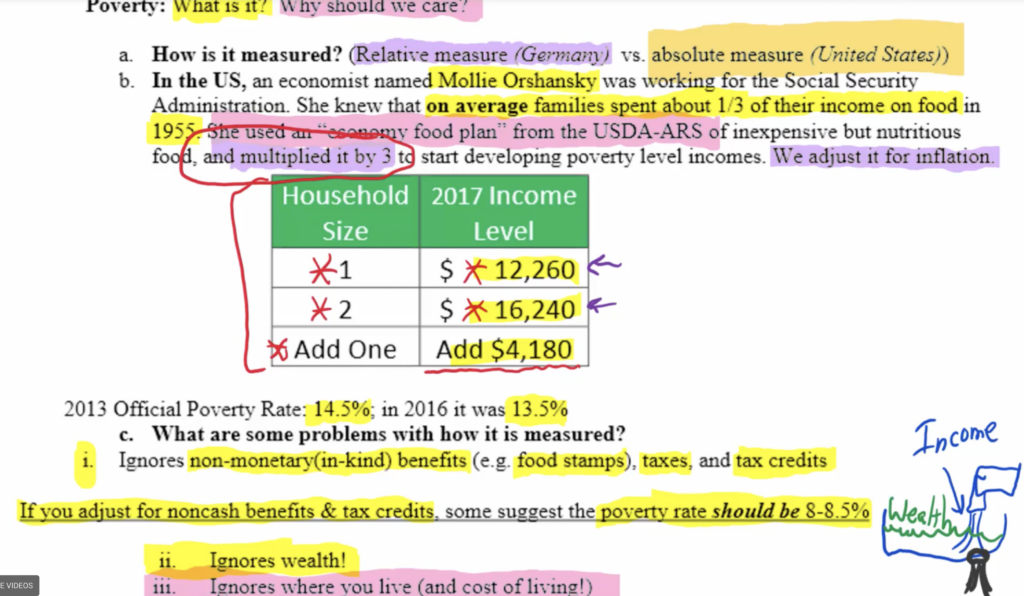
Presentation Style: Moves through definitions with slides that include a few images but a lot of text and number
Audience Engagement: Lengthy lecture format and limited interaction
Justification: Here is one bad example showing that students may be distracted by different colours. Moreover, there is too much text and too many numbers with no images, which is not accessible for all types of learners. Therefore, students might have confusion or questions during the learning process, but there is no platform for them to ask questions. There will be no active learning or cognitive engagement in this learning process. The curriculum should be redesigned to make the teaching method clearer by including images and captions that can help all kinds of learners learn. Last but not least, even though the goal is to help students gain a better understanding of economic concepts and how to solve problems involving different numbers, the design of the PowerPoint is not organized. Thus, it might make students even more confused, and it will be hard for them to follow the lesson.
Criteria
0-2 Need Additional work
3 Marginally Meet Expectation
4 Fully Meet Expectation
5 Exceeds Expectation
Theories of Multimedia Critique
This resource relies almost entirely on text and numbers. There are only a few images, but heavy text, particularly for abstract mathematical ideas.
Multimedia elements are present, but some principles are missing or may be inconsistently applied
Multimedia design accurately and intentionally employs various CTML principles to support learning. Visual and auditory elements complement each other, reducing factors that hinder learning
Multimedia elements have a strong connection to CTML principles. Key principles are not violated. Well-designed materials that help maximize understanding through the purposeful integration of media
Active Learning and Cognitive Engagement
Learners are in a passive state, since the speaker only moves point to point. Question by question There is no active learning and cognitive engagement
Learners are in a passive position or have limited opportunities to participate. The learning path includes some opportunities for interaction, communication, or application, but these are very few.
Clear positive learning elements. The learning path is well-structured with scaffolding and extension challenges, and provides opportunities for interaction, communication, and application, but there is still room for improvement.
Learners are actively engaged in the learning process. The learning path offers well-developed, tiered instruction and extended challenges, and includes opportunities for interaction, communication, and application.
Accessibility and Universal Design for Learning
There are only texts and numbers in the whole learning process.
The system has very few auxiliary functions, the subtitles do not match the content, and the learner’s needs are not being met.
Meet key accessibility requirements and provide accessible navigation to support most types of learners. Clear structure and conforms to UDL principles.
Strong inclusive design and provide accessible navigation to support all types of learners. Clear structure and conforms to UDL principles.
Clarity of Instruction and Instructional Intent
The purpose and learning goal are unclear. The contents are confusing and disconnected
The purpose and learning goal are help student have a better understand in Economic concept but is hard for student to follow since the information are too heavy
The learning objectives are clear but not specific enough. Appropriate guidance is needed to help learners understand them.
The learning objectives are clear and specific. Strong guidance helps learners understand the objectives and promotes concept development.
Overall Evaluation/justification:
Overall, this method of teaching is a bad example in Multimedia Educational Resource. The lecture video explains what poverty is and the problems that poverty causes. The speaker moves from point to point and explains the content using slides and text. This is a passive learning style in which students are only able to listen or watch. When they have questions, there is no platform for them to ask, which is not beneficial for students. Moreover, the video is too long and has too many texts and numbers. Moreover, due to a lack of images and a lack of animation, it will reduce accessibility. Therefore, this method of learning is mostly passive viewing rather than active learning.
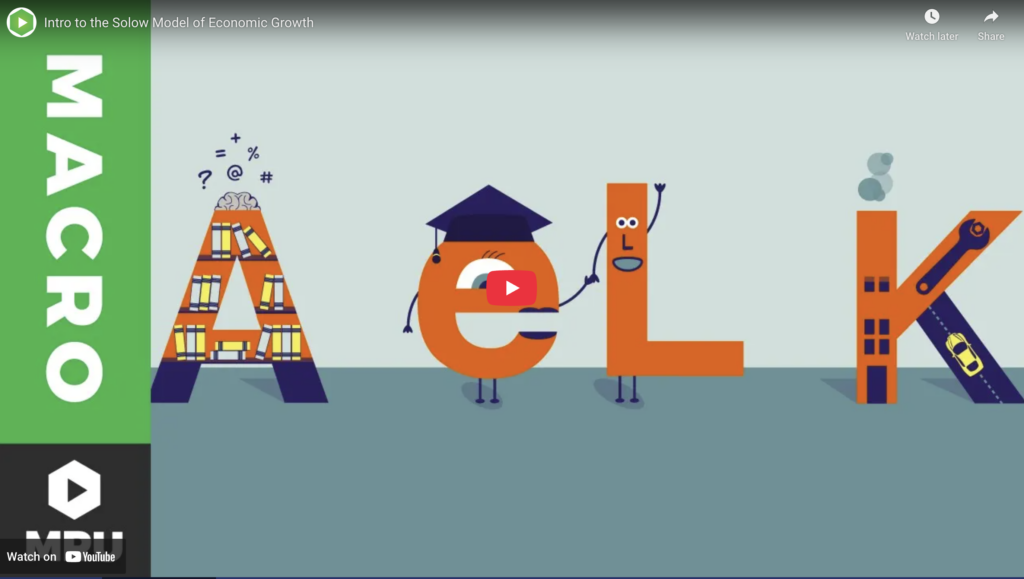
Format: Design in different short videos (around 15mins), each video focuses on one concept only. Help the learner to focus on one thing at a time.
Visuals: on-screen text, diagrams and animations.
Interaction: There will be a Q&A section, and people can ask questions.
Presentation Style: Design in different short videos with captions
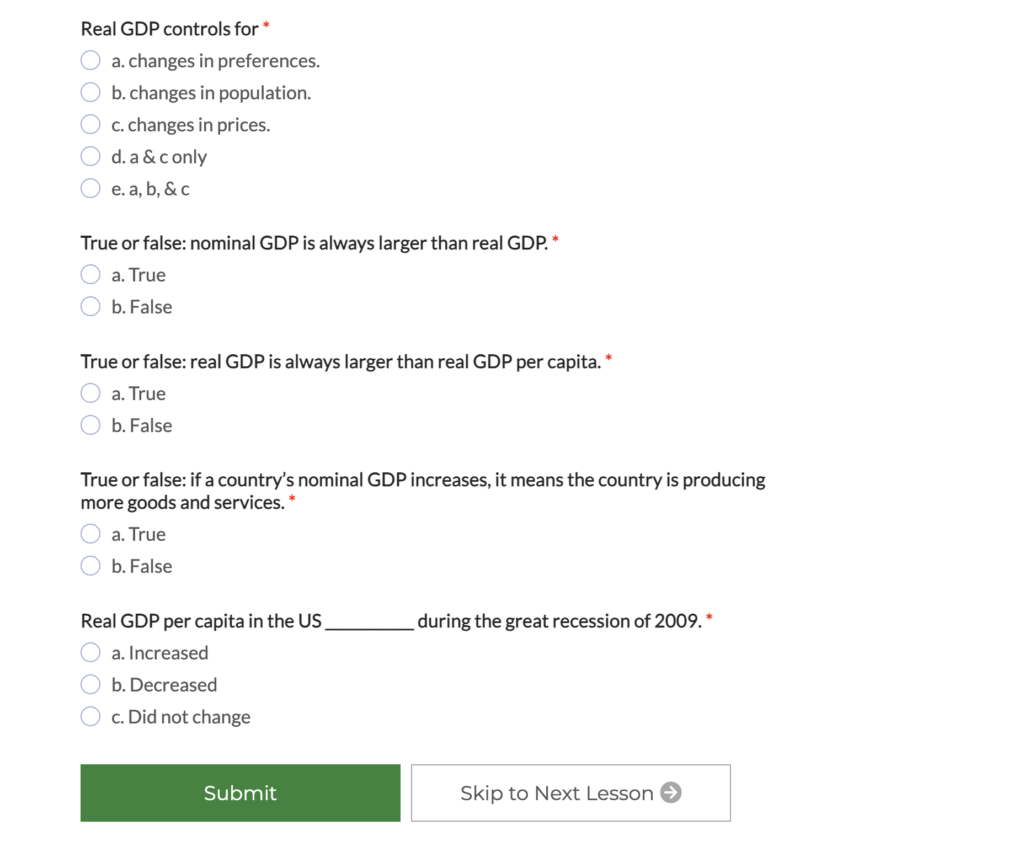
Audience Engagement: The videos are short, therefore learner to focus on the lesson itself. There are some quizes for learners to participate in different sections
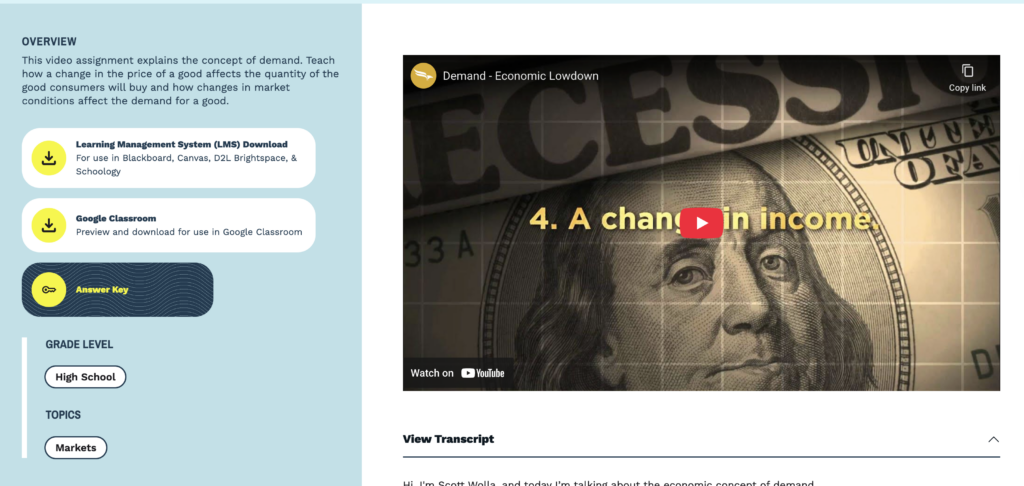
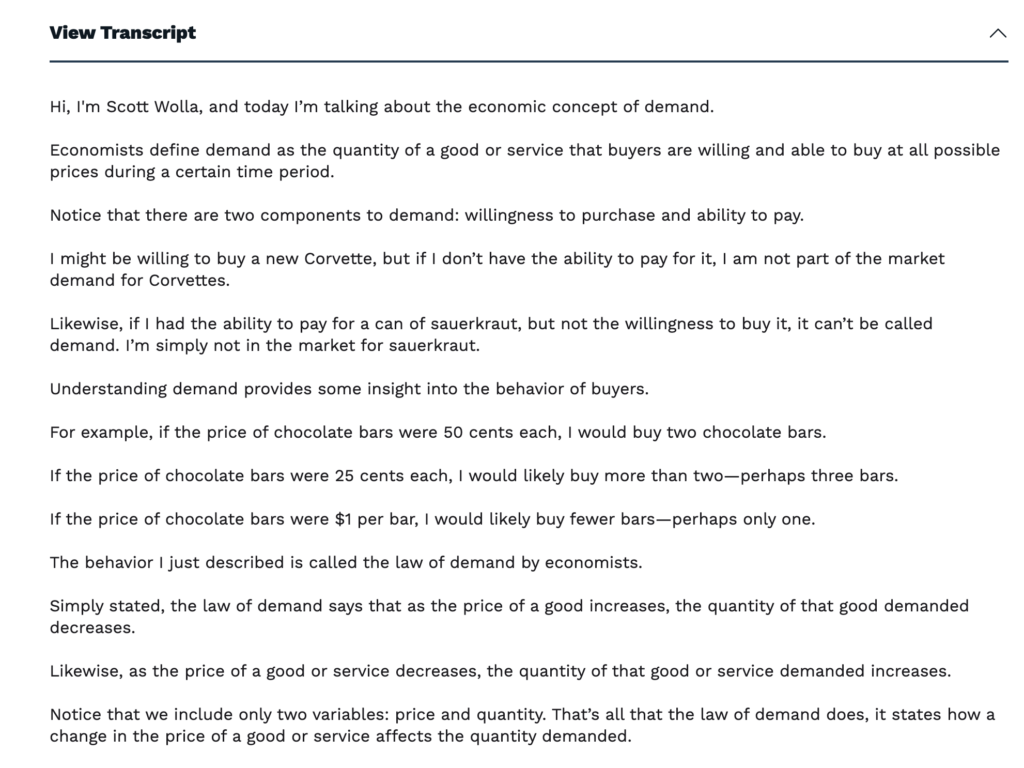
The transcript under the video can help students with different need able to receive the same information
Criteria
0-2 Need Additional work
3 Marginally Meet Expectation
4 Fully Meet Expectation
5 Exceeds Expectation
Theories of Multimedia Critique
Multimedia elements have little connection to CTML principles. Key principles are violated, increasing cognitive load. Design issues cause overload or confusion
Multimedia elements are present, but some principles are missing or may be inconsistently applied
Text, images, and videos are combined in this resource, and the content is organized into different topics. This structure helps learners quickly understand the purpose of the resources and their starting point, thereby reducing confusion and unnecessary cognitive burden.
Multimedia elements have a strong connection to CTML principles. Key principles are not violated. Well-designed materials that help maximize understanding through the purposeful integration of media
Active Learning and Cognitive Engagement
Learners are in a passive state, with little practice and feedback. There is a lack of opportunities for interaction, communication, or application
Learners go through a clear sequence of watching, trying, and receiving feedback, and the complexity of the task increases over time.
Clear positive learning elements. The learning path is well-structured with scaffolding and extension challenges, and provides opportunities for interaction, communication, and application, but there is still room for improvement.
Learners are actively engaged in the learning process. The learning path offers well-developed, tiered instruction and extended challenges, and includes opportunities for interaction, communication, and application.
Accessibility and Universal Design for Learning
Accessibility features are missing or minimal, subtitles are lacking or navigation is poor, resulting in a poor learning experience.
The system has very few auxiliary functions, the subtitles do not match the content, and the learner’s needs are not being met.
There are images with texts, and the video also includes the transcript below, which provides help for different students with different needs.
Strong inclusive design and provide accessible navigation to support all types of learners. Clear structure and conforms to UDL principles.
Clarity of Instruction and Instructional Intent
The purpose and learning goal are unclear. The contents are confusing and disconnected
The purpose and learning goal are implied but need more scaffolding. The contents cause some confusion and disconnected
The learning objectives are clear but not specific enough. Appropriate guidance is needed to help learners understand them.
The learning objectives are clear, and the learning is progressive. Students can learn one different concept at a time.
Overall Evaluation/justification:
This educational resource has a clear structure, which is easy for teachers to use. It provides thorough explanations. The multimedia supports most types of learners since it includes short videos with transcripts. Overall, I would say this is a great resource for students. Using short videos (around 10–15 minutes) that focus on one topic helps students stay focused. Moreover, the videos include some animation and captions, which can help students understand better. However, the interactive learning section is mostly limited to multiple-choice questions and lacks in-depth interactive or constructive tasks. Therefore in the Active Learning and Cognitive Engagement section, there will be some improvement for this resource.
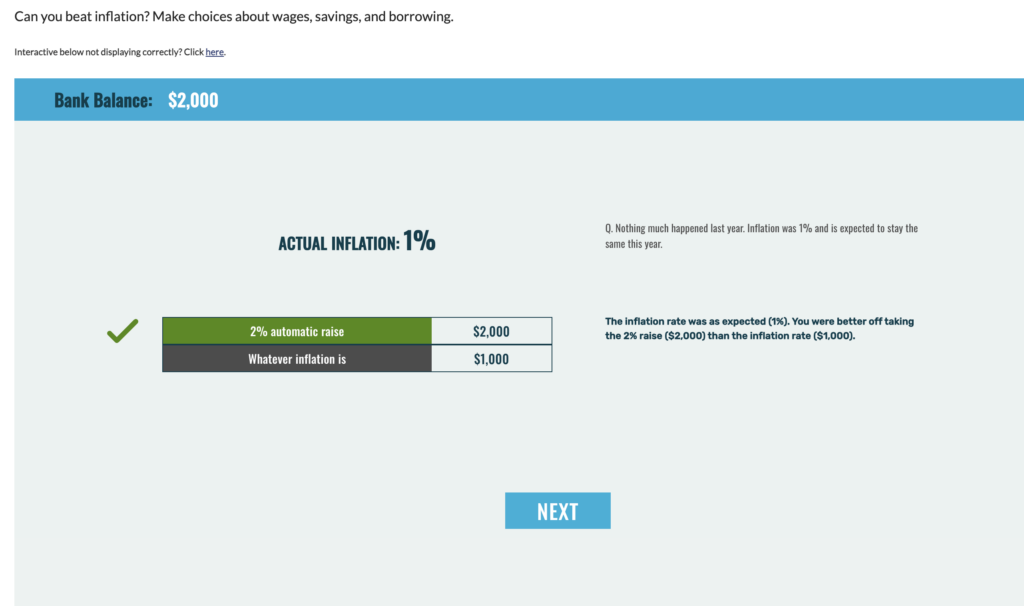
Format: Design in different short videos (around 10-15 mins), each video focuses on one concept, after each video, there will be a game to text leaner knowledge
Visuals: on-screen text, simple diagrams and funny animations.
Interaction: There will be Q&A and games sections, and learners can ask questions after each section.
Presentation Style: Design in different short videos with captions and animations
Audience Engagement: The videos are short, therefore learner to focus on the lesson itself. There are some games for learners to participate in different sections
There will be some educational videos for learners to learn for the knowledgeAfter you have learn from the video, there will be some games for you to text your knowledge The goal is make your Bank Balance higher by answering those questions right. After each section, there will be a quiz for you to test your understanding of the topic
Criteria
0-2 Need Additional work
3 Marginally Meet Expectation
4 Fully Meet Expectation
5 Exceeds Expectation
Theories of Multimedia Critique
Multimedia elements have little connection to CTML principles. Key principles are violated, increasing cognitive load. Design issues cause overload or confusion
Multimedia elements are present, but some principles are missing or may be inconsistently applied
Multimedia design accurately and intentionally employs various CTML principles to support learning. Visual and auditory elements complement each other, reducing factors that hinder learning
Text, images, videos and animation are combined in this educational resource, and the content is organized into different topics. This structure helps learners quickly understand the purpose of the resources and their starting point, thereby reducing confusion and unnecessary cognitive burden.
Active Learning and Cognitive Engagement
Learners are in a passive state, with little practice and feedback. There is a lack of opportunities for interaction, communication, or application
Learners are in a passive position or have limited opportunities to participate. The learning path includes some opportunities for interaction, communication, or application, but these are very few.
Clear positive learning elements. The learning path is well-structured with scaffolding and extension challenges, and provides opportunities for interaction, communication, and application, but there is still room for improvement.
There are different sections, which include the game model, quiz, video induction, and images. Those can help students to be more active in learning and improve the cognitive engagement.
Accessibility and Universal Design for Learning
Accessibility features are missing or minimal, subtitles are lacking or navigation is poor, resulting in a poor learning experience.
The system has very few auxiliary functions, the subtitles do not match the content, and the learner’s needs are not being met.
Meet key accessibility requirements and provide accessible navigation to support most types of learners. Clear structure and conforms to UDL principles.
There are images and animations with texts, and the video also includes the transcript below, which provides help for different students with different needs.
Clarity of Instruction and Instructional Intent
The purpose and learning goal are unclear. The contents are confusing and disconnected
The purpose and learning goal are implied but need more scaffolding. The contents cause some confusion and disconnected
The learning objectives are clear but not specific enough. Appropriate guidance is needed to help learners understand them.
The learning objectives are strong and clear, and the learning is progressive. Students can learn one different concept at a time.
Overall Evaluation/justification:
This is a great example of educational resources. I have given 20 out of 20 for this resource. First, it has a clear goal and well-designed structures. It will be beneficial for all kinds of learners since it has well designed and accessible. Since there is a clear and simple image, text, animation and number, which can met leaner with different needs. The goal of the educational resource is clear and easy to understand, which can help learners have a better understand in Economic concepts. From the evidence, we can see that the learning process is very diversified, including image, video, text, game, and quiz. Therefore, it will help students in active learning and have a better cognitive engagement. It supports teachers and learners, and it includes great in-depth interactive or constructive tasks. Students are able to ask questions after each section, and there will be a section for testing learner learning outcomes, and it will show the result to the teacher. Therefore, this will maximize the learning effectiveness and experience.